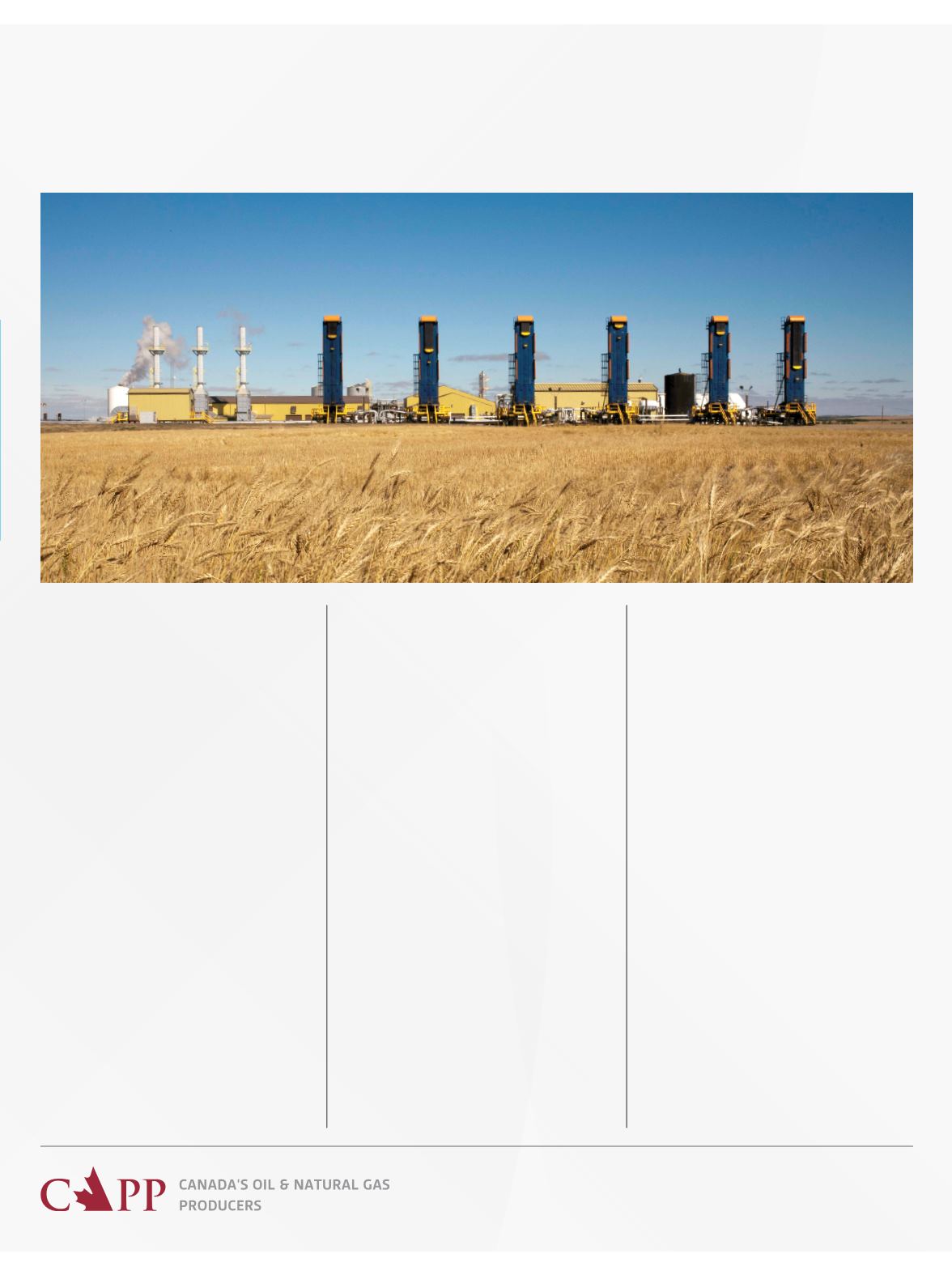
 The agriculture and energy industries
have more in common than you
might think.
Both are national in scope and are
essential to Canada’s economy
;
both
are continually finding ways to operate
with less environmental impact. And
both have increasing roles to play in
global security and prosperity.
Vital economic drivers
Through its multi-billion-dollar national
supply chain, oil and natural gas is truly
a national industry. The oil and natural
gas sector contributes $100 billion
annually to the country’s GDP and
provides more than 500,000 direct and
indirect jobs across the country. Export
of Canada’s oil, natural gas, and refined
products contributed $112.6 billion to
Canada’s economy in 2020.
Similarly, agriculture is an economic
mainstay. In 2020, Canada exported
nearly $74 billion in agriculture and
food products. The domestic market
is also critical – in 2019, Canadians
spent $244 billion on food and
beverage products.
Innovation and collaboration
Producers in both industries have
a clear line of sight to reducing
environmental impacts on air, water
and land.
Ongoing environmental performance
improvement has always been critical
to the Canadian energy sector. For
decades, the industry has been
reducing emissions, managing water
more effectively, reclaiming disturbed
land faster and enhancing biodiversity.
Like agriculture, the energy sector
relies on innovation and advanced
technologies that offer industry-wide
improvements through collaboration
and knowledge sharing.
The high degree of collaboration
among energy producers is a hallmark
of Canada’s oil and natural gas industry.
Numerous organizations facilitate
research, develop new technologies,
share best practices and provide
funding for environmental initiatives.
For instance, since 2012, members of
Canada’s Oil Sands Innovation
Alliance (COSIA) have invested $1.8
billion to develop more than 1,100
shared technologies.
Secure and reliable supply
Agriculture and energy products and
commodities also make a difference to
importing countries that need a secure
supply of energy and food.
Current world events, especially
Russia’s ongoing aggression in Ukraine,
highlight the global significance of
energy security. The opportunity to
help improve and stabilize global
energy security is not just a tremendous
opportunity for Canada’s oil and natural
gas sector, it could also be considered
an obligation to assist our allies and
trading partners. The same could be
said about supplying high-quality
agricultural products to a hungry world,
especially as supplies of staples such as
wheat are coming under pressure due
to blocked supplies from Ukraine.
Canada has a clear advantage when
it comes to offering safe, reliable,
responsibly produced energy and
agricultural products to global markets.
As a nation, we are poised to play an
ever-larger role.
The world needs more Canada!
CANADIAN AGRICULTURE AND ENERGY: LEADERS
IN INNOVATION, COLLABORATION AND SECURITY
A perspective from the Canadian Association of Petroleum Producers
CAPP.CA
The agriculture and energy industries
have more in common than you
might think.
Both are national in scope and are
essential to Canada’s economy
;
both
are continually finding ways to operate
with less environmental impact. And
both have increasing roles to play in
global security and prosperity.
Vital economic drivers
Through its multi-billion-dollar national
supply chain, oil and natural gas is truly
a national industry. The oil and natural
gas sector contributes $100 billion
annually to the country’s GDP and
provides more than 500,000 direct and
indirect jobs across the country. Export
of Canada’s oil, natural gas, and refined
products contributed $112.6 billion to
Canada’s economy in 2020.
Similarly, agriculture is an economic
mainstay. In 2020, Canada exported
nearly $74 billion in agriculture and
food products. The domestic market
is also critical – in 2019, Canadians
spent $244 billion on food and
beverage products.
Innovation and collaboration
Producers in both industries have
a clear line of sight to reducing
environmental impacts on air, water
and land.
Ongoing environmental performance
improvement has always been critical
to the Canadian energy sector. For
decades, the industry has been
reducing emissions, managing water
more effectively, reclaiming disturbed
land faster and enhancing biodiversity.
Like agriculture, the energy sector
relies on innovation and advanced
technologies that offer industry-wide
improvements through collaboration
and knowledge sharing.
The high degree of collaboration
among energy producers is a hallmark
of Canada’s oil and natural gas industry.
Numerous organizations facilitate
research, develop new technologies,
share best practices and provide
funding for environmental initiatives.
For instance, since 2012, members of
Canada’s Oil Sands Innovation
Alliance (COSIA) have invested $1.8
billion to develop more than 1,100
shared technologies.
Secure and reliable supply
Agriculture and energy products and
commodities also make a difference to
importing countries that need a secure
supply of energy and food.
Current world events, especially
Russia’s ongoing aggression in Ukraine,
highlight the global significance of
energy security. The opportunity to
help improve and stabilize global
energy security is not just a tremendous
opportunity for Canada’s oil and natural
gas sector, it could also be considered
an obligation to assist our allies and
trading partners. The same could be
said about supplying high-quality
agricultural products to a hungry world,
especially as supplies of staples such as
wheat are coming under pressure due
to blocked supplies from Ukraine.
Canada has a clear advantage when
it comes to offering safe, reliable,
responsibly produced energy and
agricultural products to global markets.
As a nation, we are poised to play an
ever-larger role.
The world needs more Canada!
CANADIAN AGRICULTURE AND ENERGY: LEADERS
IN INNOVATION, COLLABORATION AND SECURITY
A perspective from the Canadian Association of Petroleum Producers
CAPP.CA