


 15 / 30

15
overuse. As a bonus, the product has the added
benefit of increasing yields anywhere from 15 to
30 percent—a huge bonus to the grower.
What other benefits does bee vectoring
offer farmers?
Other than disease prevention and increased
yield, the BVT biologicals methodology uses
significantly less water, has no re-entry intervals
(farmers or farm workers can work while the
bees treat the crop), is organic, and doesn’t
require any large equipment. From the smallest
farm to the largest farm, all can use our product
and technology.
Relative to other technologies, what is the
cost per acre for bee vectoring?
BVT’s pricing is comparable to a traditional
chemical spray. However, with its product,
farmers receive a daily-delivered product right to
the target area. Chemical or spray applications
are limited to maybe once or twice during the
pollination period.
Is there a way to measure how successful
bee vectoring is for the farmer?
BVT tries to isolate the fields where the product
is being applied, so when it comes to the
harvest, the grower can see how much more
they have compared to non-BVT-treated fields.
The company said it can also set up replicated
trials, but those tend to be more complex and
take more time and effort.
What types of farms do you serve?
Primarily, it works on blueberries, raspberries,
blackberries, cranberries, almonds, strawberries,
and some cherries. However, the bees can work
on any pollinated crop that BVT’s bio-fungicide
will affect, such as canola.
What type of bees are used by BVT?
The company uses both honeybees and bumble
bees (Bombus impatiens), which are used
because they are both commercially available
and are the standard for commercial pollination
in most crops.
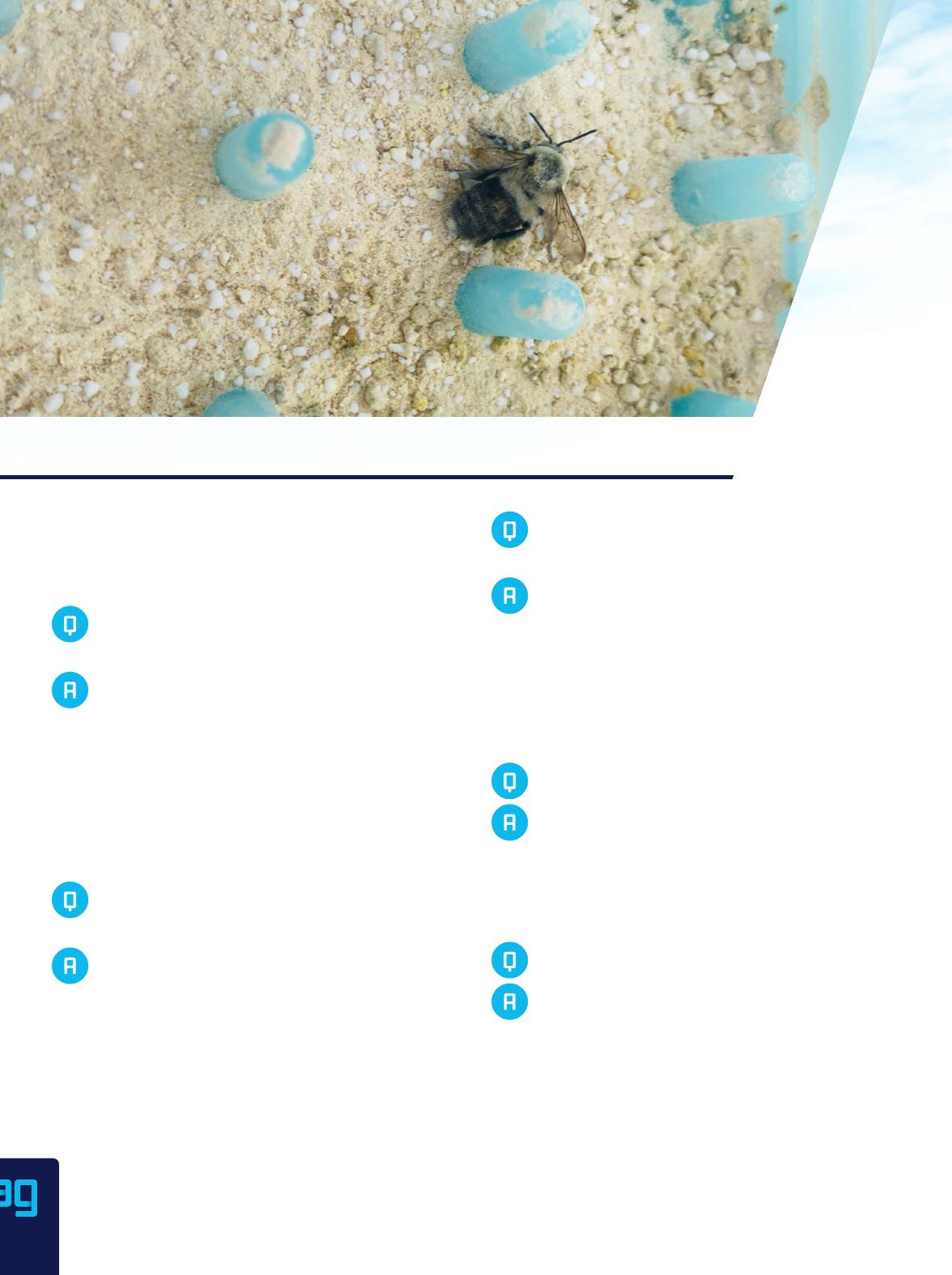
PHOTO: beevt.com
The BVT technology of precision vectoring is completely harmless to bees as they walk through it to their hive
opening, allowing minute amounts of naturally-derived pesticides to be delivered directly to blooms.
Q
A
Q
A
Q
A
Q
A
Q
A