Experts encourage producers to be proactive when it comes to safety
By Jennifer Jackson
We are halfway through Canadian Agriculture Safety Week (CASW) running from March 12 to 18 – the perfect time to reflect on the importance of safety on the farm.
The Canadian Agricultural Safety Association (CASA) and the Canadian Federation of Agriculture use the annual campaign to spread awareness about farm safety and to remind producers the importance of safety in the industry.
The week comes at an appropriate time in the year, according to Glen Blahey, agricultural safety and health specialist for CASA.
“Spring is the start of the growing season and, as the plants grow, we like to encourage producers to grow the concept of safety and make it a year long activity,” he says.
The theme for this year’s week is encouraging the involvement of the adults on the farm.
“Engaging the adult decision makers in the farm’s family unit” is crucial, says Blahey. “This (concept) does not only mean your biological family but also the community that farmers turn to for help and resources, (such as) milk truck drivers or seed suppliers.”
When producers think of safety, it should not only be about the tangible measures such as equipment guards, according to Blahey.
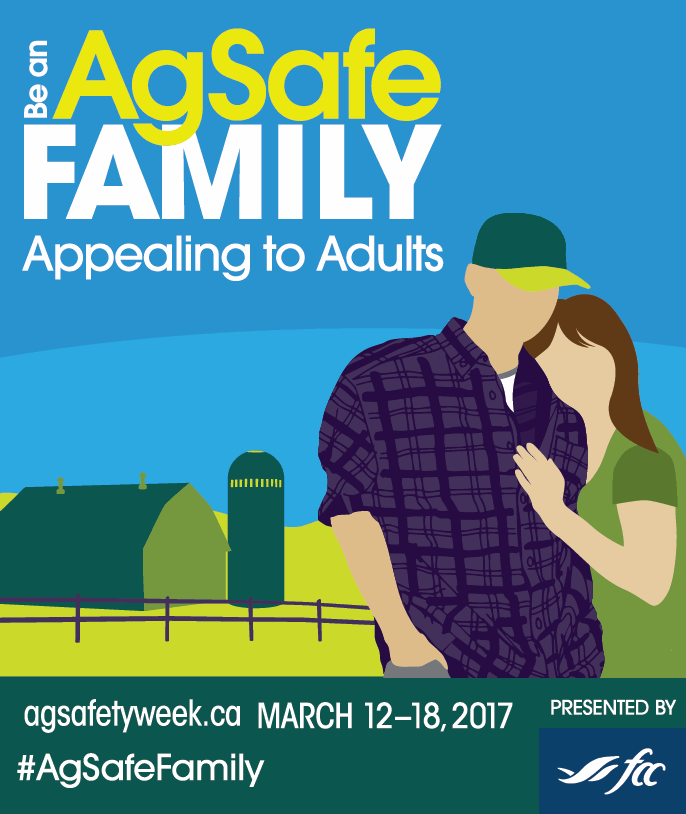
CASW Photo
One of the most important safety measures that farmers can follow is discussing the subject in everyday discussion, he advises. For his second tip, he encourages producers to ask questions and promote active conversations about farm safety protocols. And finally, he reminds us that safety should be everyone’s first responsibility, including visitors to the farm.
“A quote I like to remember from Chris Hadfield (the astronaut) is ‘plan for things to go wrong, and be prepared,’” says Blahey. “We should be asking ourselves ‘what should we do if something goes wrong.’ Let’s strive for nothing to go wrong but, if (anything) does, let’s be prepared.
“Safety is business risk management – you are managing the risk of the wellbeing of those on your farm, the risk of losing someone dear to you and also the financial risks when a preventable injury occurs.”
Many incidents that do occur on farm are in fact preventable, according to Peter Sykanda, farm policy researcher for the Ontario Federation of Agriculture.
“When we look at where most accidents come from, the vast majority relate to complacency and machinery,” he says. “It’s like driving your car to work – you go into autopilot.”
To help decrease the complacency, farmers can routinely take a step back to look at their operations and identify if there are any ways they can perform their tasks more safely, says Sykanda.
Farmers should also remember the importance of employee training and documentation, he says.
“There is no such thing as a casual employee – it’s really important for farmers to think about their own and their employees’ safety, as most incidents involve machinery users,” says Sykanda. “If someone is coming to your farm to work, you need to ensure you have trained them in safety protocols and document it.”
For more information on farm safety resources, visit the CASW website.