Farms.com Home   Ag Industry News

World record for simultaneous threshing set as part of Harvesting Hope

Record was set in Austin, Manitoba

By Diego Flammini
Assistant Editor, North American Content
Farms.com

The world record for “most threshing machines operating simultaneously” was set in Austin, Manitoba as part of Harvesting Hope.

Visitors and participants from across North America watched 139 antique threshing machines harvest a field simultaneously for 15 minutes to break the previous record of 111 machines. That record was set by a group of farmers from St. Albert, Ontario in 2015.

The record remains unofficial until it’s certified by Guinness World Records.

“This was a once-in-a-lifetime event,” Elliot Sims, co-organizer of Harvesting Hope: A World Record to Help the Hungry, said in a release. “You just don’t see stuff like this anymore.”

In total, 75 acres of winter wheat was bound and 30,000 sheaves were cut to be threshed during the event. The machines had the capacity to thresh a total of 17,000 bushels per hour.
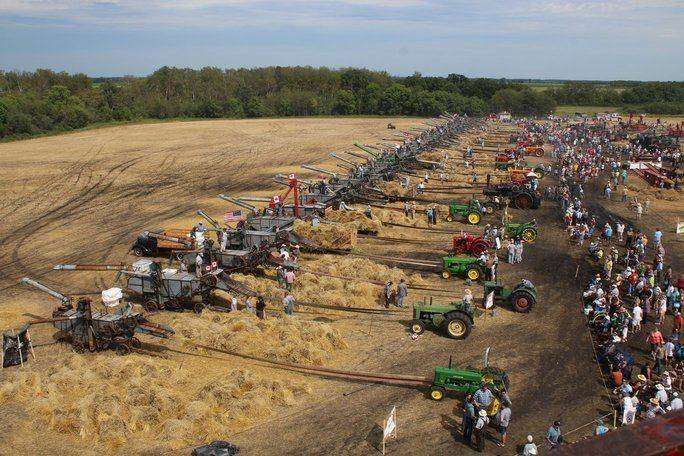
Harvesting Hope
An audience watches the threshing machines in action.
Photo: Harvesting Hope

Funds raised during the event will be split between the Manitoba Agricultural Museum and the Canadian Foodgrains Bank.

The total amount raised is still unknown, but how the funds are allocated has already been determined.

The portion going to the Manitoba Agricultural Museum will be used to help preserve the province’s agricultural heritage.

The portion going to the Foodgrains Bank will help farm families in Ethiopia, Tanzania and Kenya learn to grow more and better food.


Trending Video

How farmers are protecting the soil and our food security | DW Documentary

Video: How farmers are protecting the soil and our food security | DW Documentary

For a long time, soil was all but ignored. But for years, the valuable humus layer has been thinning. Farmers in Brandenburg are clearly feeling the effects of this on their sandy fields. Many are now taking steps to prepare their farms for the future.

Years of drought, record rainfall and failed harvests: we are becoming increasingly aware of how sensitively our environment reacts to extreme weather conditions. Farmers' livelihoods are at stake. So is the ability of consumers to afford food.

For a few years now, agriculture that focuses solely on maximum yields has been regarded with increasing skepticism. It is becoming more and more clear just how dependent we are on healthy soils.

Brandenburg is the federal state with the worst soil quality in Germany. The already thin, fertile humus layer has been shrinking for decades. Researchers and farmers who are keen to experiment are combating these developments and looking for solutions. Priority is being given to building up the humus layer, which consists of microorganisms and fungi, as well as springtails, small worms and centipedes.

For Lena and Philipp Adler, two young vegetable farmers, the tiny soil creatures are invaluable helpers. On their three-hectare organic farm, they rely on simple, mechanical weed control, fallow areas where the soil can recover, and diversity. Conventional farmer Mark Dümichen also does everything he can to protect soil life on his land. For years, he has not tilled the soil after the harvest and sows directly into the field. His yields have stabilized since he began to work this way.

Isabella Krause from Regionalwert AG Berlin-Brandenburg is convinced after the experiences of the last hot summers that new crops will thrive on Brandenburg's fields in the long term. She has founded a network of farmers who are promoting the cultivation of chickpeas with support from the scientific community.