Farms.com Home   Ag Industry News

A review of the Minneapolis-Moline G1355

The pluses and minuses of this tractor from the early 1970s

IN THE SHOP with Rachel

By Rachel Gingell
Farms.com

The Minneapolis-Moline G1355 is a powerful tractor sold at a low price - but it’s a deal that’s a little too good to be true.

While the full model name is “G1355,” many people drop the G when talking about the tractor. The Minneapolis-Moline G1355 is the same tractor as the White 2270 and the Cockshutt 2270. (Just with a different paint job). Oliver also produced this tractor - sometimes sold as the Oliver G1355, sometimes sold as the Oliver 2270. I’ll refer to the tractor as the 1355 throughout this article, but it’s exactly the same tractor sold under these different brands.

The 1355 was manufactured from 1972 to 1974. The original selling price was $11,600. I’ve only seen diesel models, but literature suggests that LP-gas was also an option.
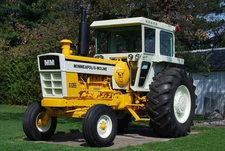
Minneapolis-Moline G1355

The 1355 is a strong tractor with more than 100 horsepower. It sells today for a very low price -around $5,000 US in good condition.

The rear end and transmission of this tractor are excellent. I’m a real fan of the Hydraul-Shift transmission used in this tractor, which shifts smoothly between 18 forward gears and 6 reverse.

The 6-cylinder diesel engine is reasonably fuel-efficient, but it has a big problem: the camshaft.

Consistent camshaft problems have plagued this model. Moline tried to correct this problem over the years, but the problem is deeper than a simple repair. I have a relative who replaced the camshaft on his 1355 multiple times only to have it repeatedly fail. This is a common scenario for the 1355 - so common that I believe this tractor spelled the beginning of the end for the Minneapolis-Moline brand.

If you never use this tractor to its full capacity, you might get away without having any camshaft problems… but what’s the use of a 100+ horsepower tractor if you can’t use all the power?


Trending Video

Western Canadian Agriculture: Hard Times Made the World's Best Farmers

Video: Western Canadian Agriculture: Hard Times Made the World's Best Farmers

Western Canadian agriculture produced the most advanced farmers in the world not through abundance but through adversity. The crow rate fell. The wheat price went nowhere. The brown envelopes stopped.

When the subsidies disappeared, the bad farmers left and the good ones stayed. And the ones who stayed could not just grow wheat anymore. They started growing lentils and canola and peas and flax and faba beans. They built crop rotation. They got serious about agronomy because there was no government backstop. That process produced the Western Canadian agriculture Dennis Bulani describes in this clip: the most advanced, most educated farming culture in the world.

His contrast with Iowa corn and soybean farmers is sharp. At a DeKalb farmer meeting in Okoboji, Iowa, he asked what crop rotation they ran. Beans on corn stubble, corn on bean stubble. How do you fertilize? The co-op agronomist handles it. Have you considered other crops? No need. We make so much money on corn and soybeans. Western Canadian agriculture was never allowed that comfort. And now those Iowa farmers are watching soybean markets lock up with China and corn prices slide, and they do not have the agronomy knowledge or the research base to pivot. Western Canadian farmers adapted on a dime because they had done it before.

Dennis also makes the case that Western Canadian agriculture keeps adapting in real time. Low commodity prices over the past year have pushed growers to look seriously at precision spot-spray technology. He knows a neighbor who bought a sprayer with the seeing-eye system and sprayed only 80 out of 320 acres. As a chemical retailer Dennis acknowledges that will affect his sales. He supports it anyway, because if it advances Canadian agriculture and makes farmers money, that is a good outcome.

The lesson Dennis draws from the tale of two farms: continuous improvement is the only durable strategy. When canola was $22 a bushel some growers went to Arizona instead of the Crop Production Show. When the price came down those same growers came back to the research and the discipline. Products do not go on Rack Petroleum's shelves unless they pass a replicated trial first. That is what Western Canadian agriculture built through hard times: farmers who do the work whether the times demand it or not.

Dennis Bulani is CEO of Rack Petroleum and Ultimate Yield in Biggar, Saskatchewan. Dan Aberhart hosts GTF Productions, Western Canadian Agriculture's foremost live briefing platform and its foremost AI training platform for ag operators