Virulent diseases which devastate food crops like coffee, almond, citrus and grapevines with serious global economic and environmental consequences, could be controlled by large-scale aerial scanning, says new collaborative research involving Swansea University.
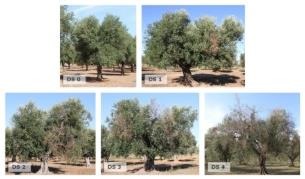
Trees showing increasing signs of disease severity.
Each year, plant pathogens causing disease result in an estimated 16% production loss globally - a level that has not significantly reduced over the last 40 years despite increased pesticide use. However, the Xylella fastidiosa (Xf) pathogen is arguably the greatest threat to crops, causing dieback, browning and loss of leaves, reduced fruit size and death and is a threat to at least 550 species worldwide.
The Xf pathogen seriously disrupts agriculture production - in the olive sector alone it has led to losses of up €5.2 billion per year. Outside America and Europe, the spread of this pathogen in Asia and Israel has intensified international calls to contain this global Xf epidemic.
Swansea University researchers from Department of Geography were part of an international team of experts from the University of Salford, the University of Melbourne (UoM), the Spanish National Research Council (CSIC), and the European Commission that scanned one million infected and healthy trees in seven regions across Europe. Using advanced imaging technology, known as hyperspectral imagery, and thermal imaging they found it could detect infectious plant diseases caused by the Xf pathogen before symptoms became visible.
The research published in Nature Communications led by Professor Pablo Zarco-Tejada (UoM and CSIC), reveals that new aerial large-scale plant crop scanning methods can achieve up to 92% accuracy in detecting Xf and could be key to successfully to containing or even eradicating it.
Click here to see more...