By Peggy Auwerda
Horse owners who want to get the most out of their pasture acres can review a new publication that explains stocking rates and forage yield factors.
“Stocking Rates: Calculating How Many Horses a Pasture Can Maintain,” is a five-page publication that details how many acres are required per horse, based on horse and pasture condition. Published by Iowa State University Extension and Outreach, the guide provides useful charts that detail how much acreage each kind of horse requires.
“The goal is to look at how many acres a person has and whether you want to feed a horse only on pasture, or update that pasture using a rotational grazing system,” said Peggy Auwerda, associate professor in animal science and extension equine specialist at Iowa State.
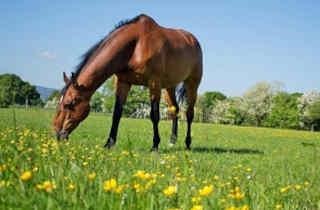
The type of pasture plays a significant role in stocking rate. A pasture planted with orchardgrass and some alfalfa can produce from 2 to 5 tons per acre per year, dependent on rainfall, species of plants, soil type, fertilization and management.
Horses that are used for heavy work or mares that are in late lactation require the most nutrients from pastures, while weanlings and horses on maintenance diets require less.
Horse owners can plug in their own numbers using the charts, to determine their personal pasture needs and capabilities.
Auwerda said the stocking rate question is one she often is asked, so she decided to put a publication together using information similar to what beef cattle producers use when determining stocking rates for cattle.
She said equine owners often only have a few acres, and making the most of those acres is important, to save on feed costs and preserve the quality of the pasture. Even with very small pastures of a couple acres, she said it makes sense to manage those effectively and to implement a rotational grazing system, so that the grazed portion can recover.
“Horse owners should strive to get the most out of the land they have, not only for nutrition and grazing, but also for exercise and the wellbeing of the horse,” she said.
Source : iastate.edu