By Gary Schnitkey and Jonathan Coppess et.al
Department of Agricultural and Consumer Economics
University of Illinois
Carl Zulauf
Department of Agricultural, Environmental and Development Economics
Ohio State University
In the August version of the 2023 Illinois Crop Budgets, wheat plus double-crop soybean is projected to be much more profitable than stand-alone corn and stand-alone soybeans in southern Illinois. Wheat-double-crop-soybeans has a much smaller advantage in central Illinois. Farmers considering adding wheat into their rotations should consider pricing some of the wheat. Increases in wheat acreage could lead to declines in wheat prices.
Southern Illinois Budgets
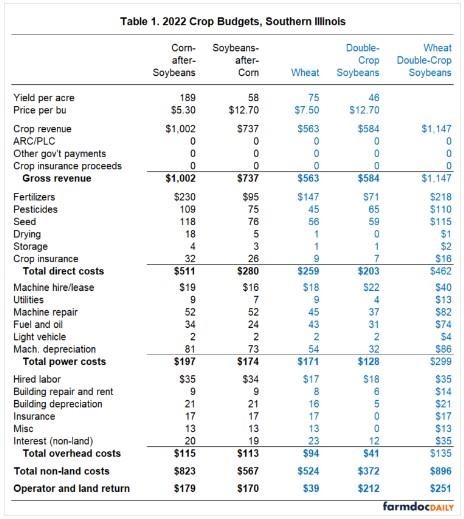
Operator and land return equals gross revenue minus non-land costs, representing a return to both the landowner and farmer. For southern Illinois, operator and land return is projected at $39 per acre for wheat and $212 for soybeans-after-wheat, giving a $251 return for the combination of wheat and double-crop soybeans (see Table 1). The $251 return for wheat-double-crop soybeans is $81 higher than for stand-alone soybeans ($170 per acre), and $72 higher than for corn ($179).
Prices in the budgets are $5.30 per bushel for corn, $12.70 for soybeans, and $7.50 for wheat. These prices are near current bids for fall 2023 delivery. While these fall bids are relatively high, 2023 budgets (farmdoc daily, March 29, 2022) prepared early in March had higher prices of:
- $5.60 for corn, higher by $.30 than the $5.30 price in August budgets,
- $13.10 for soybeans, higher by $.40 than $12.70 prices in August budgets, and
- $8.50 for wheat, higher by $1.00 than the $7.50 in August budgets.
All commodity prices have come down as market participants absorbed the implications of the Ukraine-Russia war. Overall, the conflict caused wheat prices to increase relative to corn and soybean prices. Recent price reduction reduced wheat double-crop-soybeans’ advantage over corn and soybeans. In March budgets, wheat-double-crop soybeans had a $205 advantage over soybeans, compared to the near $81 advantage in Table 1.
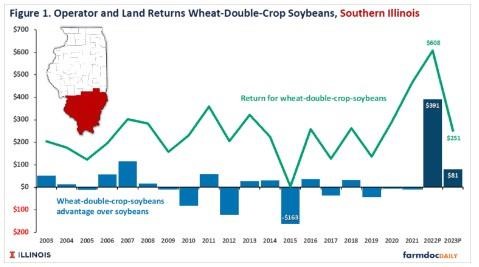
While exceeded by the 2022 advantage, the $81 projected advantage for wheat double-crop soybeans in 2023 is one of the largest in recent history. From 2003 to 2021, the wheat-double-crop-soybeans return averaged of $2 per acre lower than soybeans (see Figure 1). The 2022 difference is projected at $390, a much higher level resulting from record high wheat prices and near-record wheat yields. Note that 2022 returns are still projected as 2022 corn and soybean have not been harvested, and sales prices could vary from current projections for the June 1, 2022 to May 31, 2023 marketing year. The 2022 projections will become final once Illinois Farm Business Farm Management (FBFM) values are summarized next March.
Central Illinois High-Productivity Budgets
For high-productivity farmland in Central Illinois, operator and land return for wheat is projected at $198 per acre for wheat and $212 for double-crop soybeans, giving a projected return of $410 per acre for wheat-double-crop-soybeans (see Table 2). This $410 projected return is $26 higher than the $384 return for stand-alone soybeans. The wheat double-crop soybean combination’s advantage is much lower in central Illinois compared to southern Illinois.
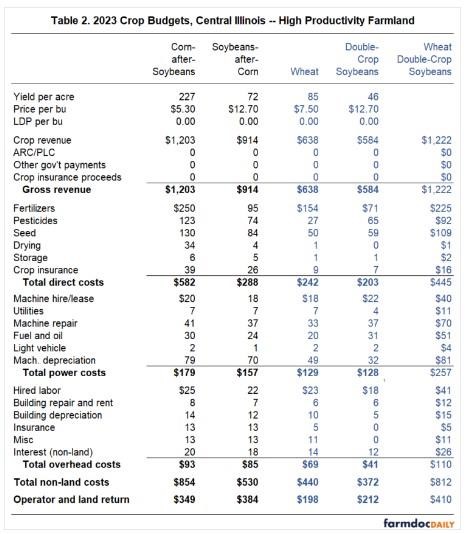
The $26 advantage for the wheat double-crop soybeans combination may entice some farmers to plant wheat. However, as farmers consider the practice, we note the following:
- Making wheat-double-crop-soybeans profitable requires management. Generally, Illinois farmers have been moving to an intensive management system for wheat that involves fungicides to maintain grain quality. Harvesting wheat early at relatively high moisture is key to preserving wheat quality and planting double-crop soybeans quickly. Of course, planting soybeans in late June/early July involves weather risks, and occasional low yields should be expected for double-crop soybeans.
- Farmers without wheat-double-crop-soybeans experience should consider the learning curve associated with new systems. The profitability of a management practice or system usually increases with experience. Hence, those farmers with a longer-run interest in wheat-double-crop-soybeans likely will find potential 2023 returns more motivating.
- Wheat-double-crop-soybeans have both environmental benefits and rotational considerations. The wheat will act like a cover crop, which has the potential to reduce nitrates leaving the fields. Often, rotational studies find that including wheat will increase subsequent corn yields as nitrogen is retained.
- The Risk Management Agency (RMA) will make obtaining crop insurance on double-crop acres easier for Illinois counties that have not had a double-crop soybean practice before this year. RMA most likely will implement a standardized written agreement available for double-crop soybeans. However, farmers who do not have a history of double-crop soybeans will have to rely on transition yields for determining guarantees. The use of t yields often results in very low crop insurance guarantees.
The above considerations suggest that growing the wheat-double-crop-soybeans likely should be a management practice longer than one year. Farmers considering wheat-double-crop-soybeans before the Ukraine-Russian War may find current prices motivating to move into the practice.
Commentary
Much of the advantage of wheat double-crop soybeans relative to stand-alone corn and soybeans results from relatively high wheat prices. The Ukraine-Russia conflict is the proximate cause of relatively high wheat prices. As uncertainty is removed or market participants become used to the conflict’s implication, the wheat price advantage may dissipate. Moreover, significant increases in wheat acres could result in downward price pressures on wheat. As a result, farmers growing more wheat should consider pricing more of the wheat at this time.
Source : illinois.edu