By Brandon Van Soest and Miriam Weber Nielsen et.al
New research from Michigan State University provides insight into the impacts of providing transition milk to calves early in life.
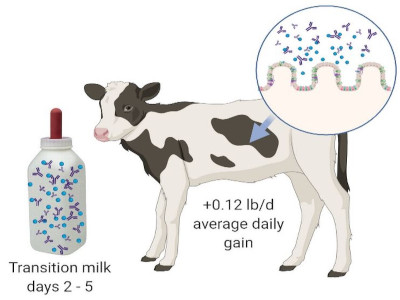
Results of a recent Michigan State University study demonstrated that feeding transition milk improved gut health and growth rates of dairy calves.
Dairy producers have long understood the importance of quickly providing newborn calves with colostrum – the first secretion from the udder after the cow gives birth. However, little attention has been paid to transition milk, produced in the 2nd through 4th milkings after calving. As the udder gradually transitions from colostrum production to making mature milk, this intermediate milk not only contains more energy and protein than mature milk, but also includes immunoglobins and other potentially beneficial factors.
Transition milk can be collected into the bulk tank just as mature milk is, but this approach may fail to capture the full value of this milk. In a study conducted by Michigan State University investigators, calves were provided colostrum, then fed two quarts of transition milk three times per day for nine feedings prior to receiving milk replacer on day five of life. These heifer calves were compared to peers fed two quarts of milk replacer at each feeding after colostrum feeding. Heifers fed transition milk achieved greater weaning weights (+6.6 pounds on average). Additionally, both the published study as well as a follow up study (publication in progress) found improvements in observational health scores and blood health markers when calves were fed transition milk.
While this initial study did not dive further into the reasons that transition milk confers these benefits, the follow-up study showed that transition milk stimulates development of the digestive tract through cell proliferation (increasing cell numbers) which ultimately increases small intestinal surface area and potential nutrient absorption. Calves not receiving transition milk may be missing out on the opportunity for increased gut development and improved health.
To justify the feeding of transition milk on farms, it must be feasible, economical, and beneficial. Dairy managers should consider the value of additional weight gain and improved calf health in their operation, keeping in mind the evidence that improved early-life growth and health may result in increased lifetime milk production. Based on relationships from an analysis published in 2012, the 0.12 pound per day increase in average daily gain in this study would be predicted to result in 387 pounds of additional first-lactation milk yield.
On the other hand, implementing transition milk feeding would come at some cost. Dairy farms may see increased cost of labor and supplies for collection, pasteurization (if desired), storage, and reheating transition milk. For farms currently discarding transition milk, this feeding approach could prove to be an attractive option. Likewise, in a herd with an automated milking system, the collection may be as simple as making a few adjustments to the robot and having an additional tank to separate transition milk, but logistics would likely be more challenging on other farms.
An alternative option is supplementing milk replacer with a colostrum replacer. In the published study, feeding a 50:50 blend of colostrum replacer and milk replacer achieved growth and health responses similar to those from feeding transition milk. Although this approach could be more appealing from a labor standpoint, it may be difficult to justify feeding 150 grams of relatively expensive colostrum replacer per feeding for three days on top of the milk replacer cost.
Research on optimal nutrition for calves after the first colostrum feeding is limited. On farms where feeding transition milk or supplementing with colostrum replacer is feasible, improved health and faster growth in of calves may be achieved.
Source : msu.edu