Farms.com Home  › News

U.S. Dairy Exports Strong In September

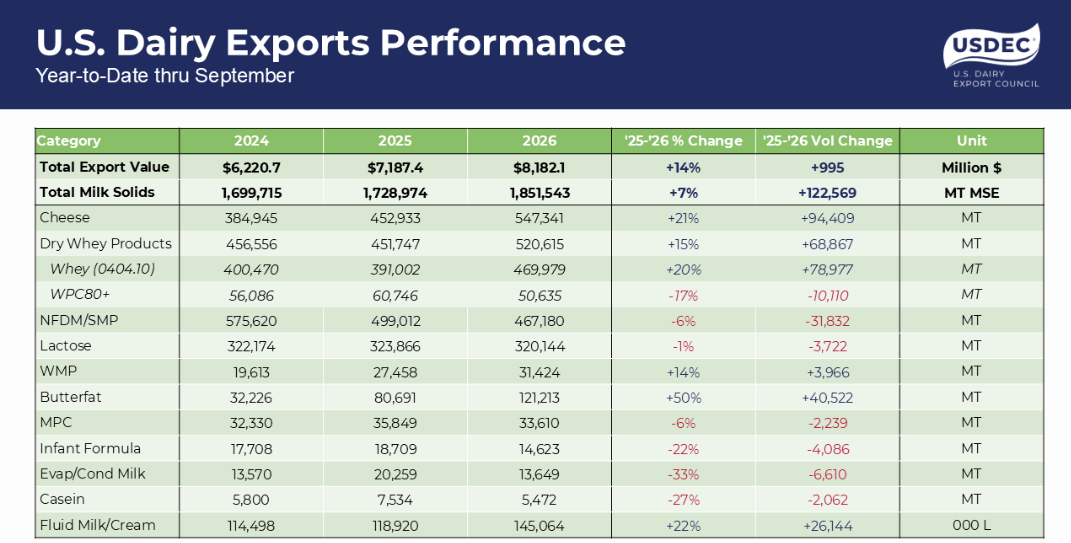
Robust global demand drove up year-over-year (YOY) U.S. dairy exports by 10% on a milk solids equivalent (MSE) basis in September. All product categories except anhydrous milkfat (AMF), lactose, and milk protein concentrate posted gains. 

Dairy’s affordable nutrition, taste, and functionality continue to drive consumption growth worldwide. Despite elevated dairy protein prices, the UN Food and Agriculture Organization Food Price Index shows dairy remaining relatively stable (and lower than 2024 and 2025) amid more rapidly rising prices for other food products, such as vegetable oils and cereals. 

Strong overall dairy trade results (including from the two top global suppliers, New Zealand and the EU) attest to dairy’s unique position. As USDEC’s latest International Demand Analysis points out, August was the 15th straight month of YOY global dairy trade growth, and volume is tracking to almost certainly set a new record this year. If U.S. September numbers are any indication, September should be the 16th straight month of growth. 
crops

Click here to see more...

Trending Video

Season 7, Episode 6: Using Competitive Exclusion to Reduce E. coli in Weaned Pigs

Video: Season 7, Episode 6: Using Competitive Exclusion to Reduce E. coli in Weaned Pigs

Newly weaned pigs are especially vulnerable to pathogenic E. coli, which can cause diarrhea and other health challenges. Research is exploring how introducing beneficial bacteria before exposure to harmful bacteria could help reduce the severity of post-weaning disease, with timing playing an important role.

Dr. Marcelo Almeida, assistant professor in Iowa State University’s College of Veterinary Medicine, and Dr. Rodrigo Paiva, graduate student and pathology resident at the Iowa State University Veterinary Diagnostic Laboratory, discuss their research on competitive exclusion in weaned pigs. They explain how this approach works, why introducing beneficial microorganisms before E. coli exposure may improve outcomes and what they learned about diarrhea, E. coli shedding and pig performance. The conversation also explores the potential to address antimicrobial resistance and the considerations for applying these findings in commercial pork production.