The U.S. Department of Agriculture’s Animal and Plant Health Inspection Service (APHIS) has confirmed the presence of box tree moth, Cydalima perspectalis, in the continental United States and is taking action alongside state partners and industry to contain and eradicate the invasive pest that was imported on nursery plants shipped from Ontario, Canada.
The box tree moth can significantly damage and potentially kill boxwood plants if left unchecked. Between August 2020 and April 2021, a nursery in St. Catharines, Ontario shipped boxwood (Buxus species) that may have been infested with box tree moth to locations in six states—25 retail facilities in Connecticut, Massachusetts, Michigan, New York, Ohio, and South Carolina—and a distribution center in Tennessee. At this time, the pest has been identified in three facilities in Michigan, one in Connecticut, and one in South Carolina, and APHIS is working with state plant regulatory officials to determine whether other facilities may be impacted.
On May 26, 2021, APHIS issued a Federal Order to halt the importation of host plants from Canada, including boxwood (Buxus species), Euonymus (Euonymus species), and holly (Ilex species). In addition, APHIS is coordinating closely with the affected States to:
- Find and destroy the imported plants in the receiving facilities
- Trace imported plants that were sold to determine additional locations of potentially infected boxwood
- Provide box tree moth traps and lures for surveys in the receiving facilities and other locations that received potentially infected boxwood
- Prepare outreach materials for State agriculture departments, industry, U.S. Customs and Border Protection Agriculture Specialists stationed along the Canadian border, and the public.
These immediate measures are focused on protecting the economic viability of the thriving U.S. boxwood industry as well as nurseries and other establishments that sell these plants wholesale and direct to consumers.
The box tree moth is native to East Asia and has become a serious invasive pest in Europe, where it continues to spread. In 2018, it was found in the Toronto area of Canada. The caterpillars feed mostly on boxwood and heavy infestations can defoliate host plants. Once the leaves are gone, larvae consume the bark, leading to girdling and plant death.
Members of the public can prevent the box tree moth from spreading. Please allow State or Federal agricultural officials to inspect your boxwood trees and place an insect trap if they visit your home. If you bought a boxwood plant within the last few months, please inspect it for signs of the box tree moth and report any findings to your local USDA office or State agriculture department.
Here are some signs to help identify the presence of box tree moth:
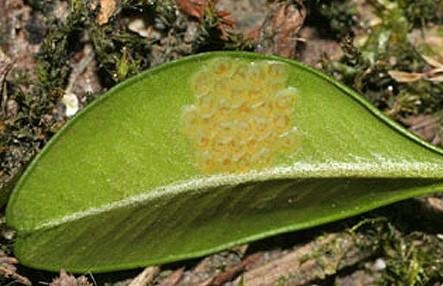
Egg mass under the leaves
(Courtesy of Walter Schön, www.schmetterling-raupe.de/art/perspectalis.htm)
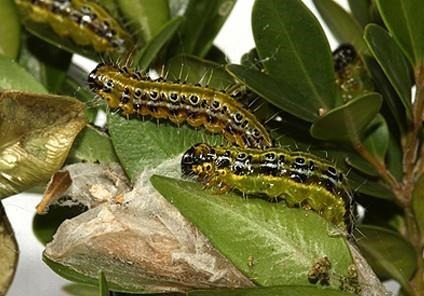
Caterpillars and webbing (larvae can reach 1.5 inches long)
(Courtesy of Matteo Maspero and Andrea Tantardini, Centro MiRT - Fondazione Minoprio [IT].)
Adult moths (wingspan is 1.5 to 1.75 inches):
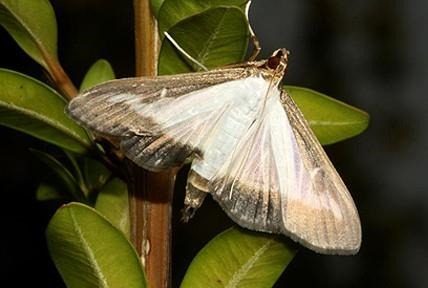
(Courtesy of Matteo Maspero and Andrea Tantardini, Centro MiRT - Fondazione Minoprio [IT].)
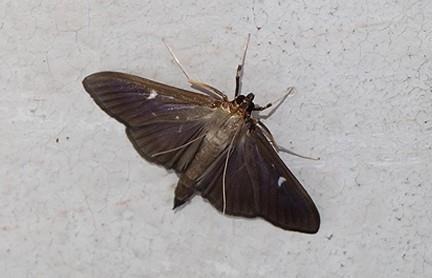
Dark form of the moth.
(Courtesy of Ilya Mityushev, Department of Plant protection of the Russian State Agrarian University - Moscow Timiryazev Agricultural Academy.)
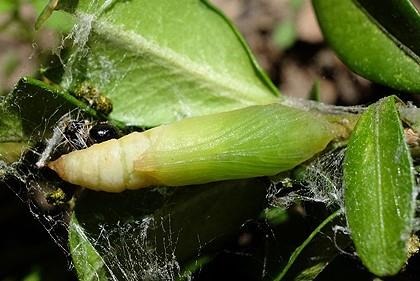
Pupa
(Courtesy of Ilya Mityushev, Department of Plant protection of the Russian State Agrarian University - Moscow Timiryazev Agricultural Academy.)
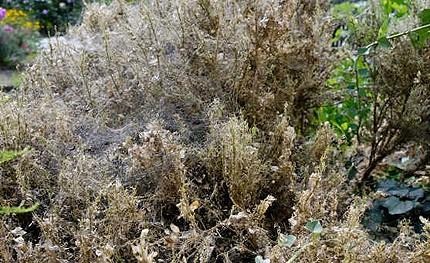
Damage
(Courtesy of Colette Walter, http://www.lepiforum.de/webbbs/images/forum_2/pic13983.jpg).
Source : usda.gov