By Maira Duffeck and Marian Luis
Wheat is now between Feekes 8 (flag leaf emergence) and Feekes 10 (boot) across the state. Feekes 8 marks the beginning of the period during which we recommend that you begin scouting fields to determine which disease is present and at what level. Septoria tritici leaf spot is usually one of the first to show up, and it has already been reported in some fields. So far, it is restricted to the lower leaves and severity is low in most of the affected fields. This disease is favored by cool (50-68F), rainy conditions, and although it usually develops early in the season, it really does not cause yield loss unless it reaches and damages the flag leaf before grain fill is complete.
Like many other foliar diseases, Septoria reduces grain fill and the size of the grain. It usually does not affect the number of spikelets per spike, an important yield component that is defined very early in the development of the plant. A fungicide application at this time will control Septoria and powdery mildew, another disease that usually shows up early under cool conditions, protect the flag leaf, and minimize grain yield loss. If the weather conditions continue to be rainy and favorable for foliar disease develop, spores will continue to be produced or blown in from other areas, and new infections will occur, particularly if the variety is susceptible.
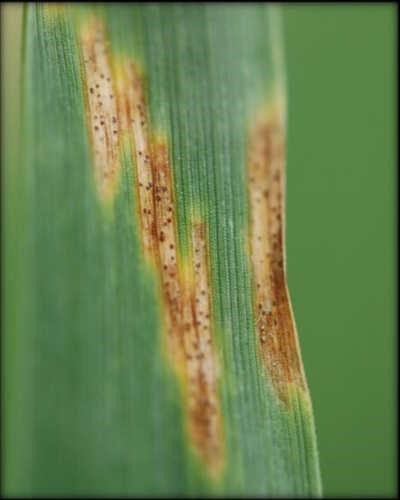
Septoria on wheat
Results from previous studies have shown that the greatest benefits from foliar fungicide applications were seen when applications were made to a susceptible variety between Feekes 8 and 10. This is largely because most of our major foliar diseases usually develop and reach the flag leaf after Feekes 8-9. However, the residual effects of a Feekes 8-9 fungicide application will not adequately protect the head from late season diseases such as head scab and Stagonospora glume blotch or the flag leaf from rust and Stagonospora leaf blotch. In addition, some of the fungicide that effectively control foliar diseases are ineffective again, or are not recommended for control of, head scab.
There are several very effective fungicides available for use on wheat (see resource chart). Carefully read labels before making an application.
Source : osu.edu