Wheat ranks third behind corn and soybeans among U.S. field crops in planted acreage, production, and gross farm receipts. In 2026/27, U.S. farmers are estimated to have produced a total of 1.53 billion bushels of winter, spring, and Durum wheat from a harvested area of 31.9 million acres. Wheat plantings and production have followed a long-term downward trend, although the decline in production is partly mitigated by rising yields. Since peaking in 1981, U.S. wheat area planted has declined by 46 million acres and production has decreased by about 1.3 billion bushels.
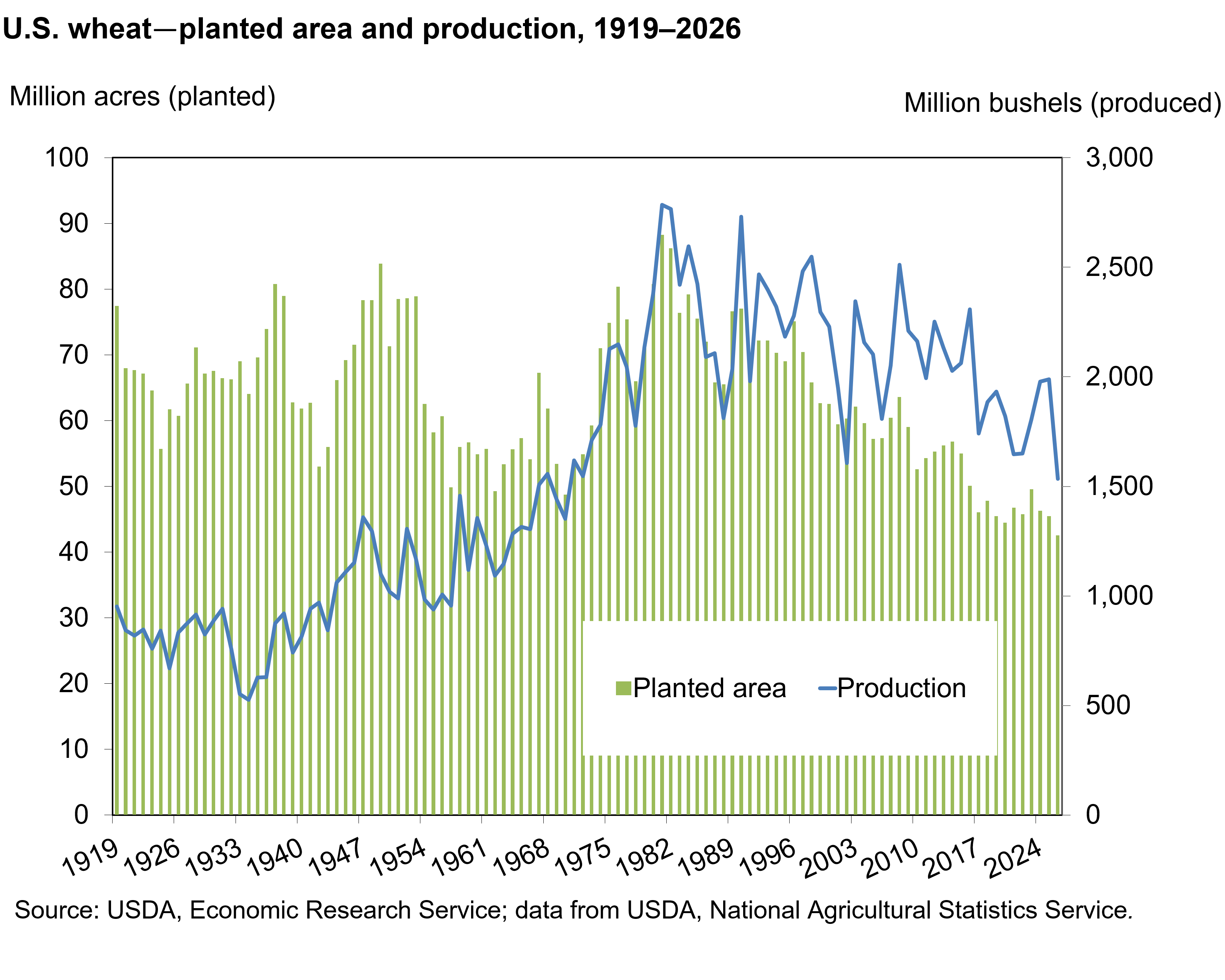
Download chart image
Download chart data in Excel format.
As competition in global wheat markets has grown, farmers’ returns for planting wheat in the United States have declined relative to other crops, which has motivated some farmers to reduce wheat plantings. Changes in farm legislation in the mid-1990s that allowed farmers more flexibility when choosing crops to plant also reduced wheat acreage.
Specifically, the 1996 Farm Act strengthened the market orientation of crop planting by eliminating the requirement that farmers maintain base acreage of a crop to qualify for Government payments. In addition, area planted for wheat lost ground to technological innovations that improved production prospects for corn and soybeans. Genetic improvement has been slower for wheat because of the food grain’s significantly more complex genetics and lower potential returns from research investments. Farmers grow wheat primarily for human food use, and U.S. food processors are wary of consumers’ reactions to products containing genetically modified wheat. No genetically modified wheat is commercially grown in the United States.
U.S. Wheat Classes
Wheat is the principal food grain produced in the United States. The three primary varieties of the grain domestically sown are winter wheat, spring wheat, and durum wheat.
Winter wheat varieties are sown in the fall and usually become established before going into dormancy when cold weather arrives. In the spring, plants resume growth and grow rapidly until the summertime harvest. Winter wheat production represents nearly 70 percent of the total U.S. production, on average.
Source : usda.gov