Technology allows farmers to see more
By Diego Flammini
Assistant Editor, North American Content
Farms.com
Drones are helping farmers in Ontario take agriculture to new heights.
Dr. Mary Ruth McDonald from the Ontario Agricultural College at the University of Guelph, said drones have become an important tool in a farmer’s toolbox in the last decade.
"Even before that, people were interested in satellite images to assess crops. In the last 10 years, the whole area has really exploded to include things like using drones to spray areas that are difficult to access, and using drones for things like counting apples in an orchard," McDonald told CBC.
There are many advantages of using drones, including accessing different landscapes, and more detailed imagery than the human eye is capable of.
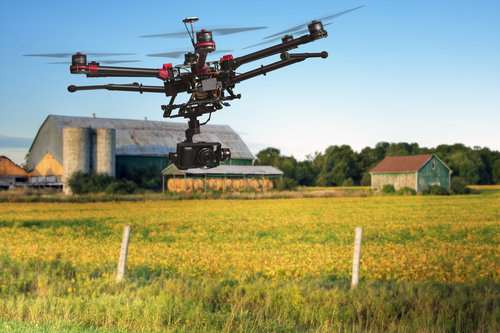
“The images provided by the drone and counting the pixels are a finer and more accurate assessment of the amount of disease in a plot or a treatment,” McDonald told CBC.
Another benefit for farmers, and maybe the most important one, is that using drones can help them save money.
Farmers are able to scout an entire field and make informed decisions on what their crops need.
A farmer contemplated adding nitrogen to his entire wheat field over the winter. After having a drone do a flyover, the farmer's support group came up with a different decision.
"My recommendation was not to apply nitrogen where there wasn't enough wheat,” Felix Weber, who operates Ag Business & Crop in Palmerston, Ontario, told CBC. “That was a cost savings to the farmer and 80 per cent of nitrogen was added rather than 100 per cent.”