Incipio includes a novel Group 30 mode of action
A new tool is available for Canadian potato and specialty crop growers to protect their crops from insect pressure.
Syngenta recently introduced Incipio foliar insecticide, which includes a novel Group 30 mode of action called PLINAZOLIN. (Click here to go to Incipio’s specialty crop page).
“It works through contact and ingestion,” Cheryl Trueman, Syngenta’s insecticide and fungicide technical lead for potato and specialty crops, told Farms.com. “It interferes with nerve and muscle signaling. The muscles can contract but they can’t relax, so insects will stop feeding.”
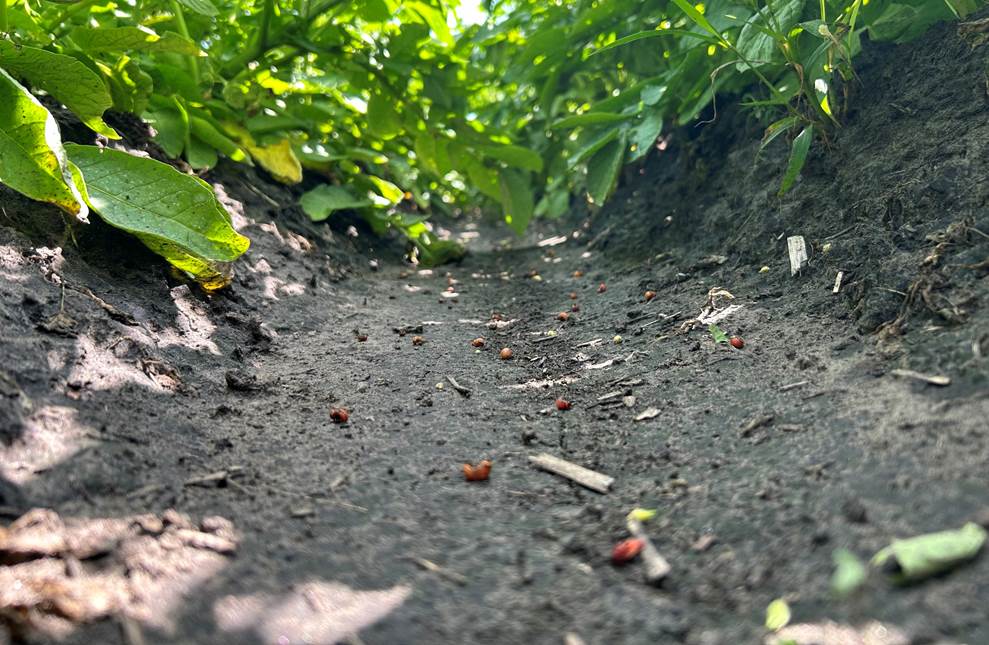
Validation trial in Manitoba on CPB in potatoes (Syngenta photo).
In potato crops the insecticide helps control Colorado potato beetle, potato leafhopper, and European corn borer. In specialty crops farmers can expect to see control on a wide range of pests including cabbage looper, diamondback moth and multiple mites.
“In apples we’ve seen that for European red mite and two-spotted spider mite, Incipio works on all the mobile stages of these mites, but it also has activity on eggs,” Trueman said.
Incipio’s formulation gives it two-hour rainfastness and can provide residual control for up to 14 days.
And trials across Canada show the insecticide works well in various conditions.
“We’ve seen very good performance across different environments,” Trueman said. “And we’ve seen Incipio pairs well with other products like Minecto Pro (Group 6 plus a Group 28), to give farmers multiple modes of action.”
Applications depend on local thresholds, Trueman added.
Incipio will be available for the 2027 growing season and sold in cases of 4 x 0.81 L.
In potatoes, one case treats about 80 acres when directed at Colorado potato beetle, or 53 acres targeting European corn borer.
One case will also treat 53 acres of apples and 80 acres in brassica crops.
Farmers interested in learning more about Incipio can contact a local Syngenta rep.
Growers can also visit the Farms.com Field Guide for information on how to control crop pests.