By Manasasri Muralidharan
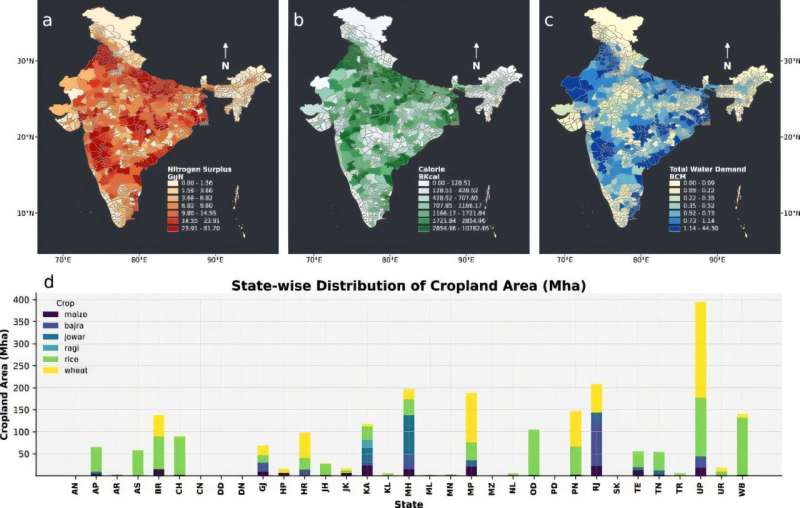
A new study from the Indian Institute of Technology Gandhinagar (IITGN) and the Helmholtz Centre for Environmental Research (UFZ) has shown that redesigning India's cereal cultivation patterns around nitrogen management could significantly reduce environmental damage while maintaining calorie production and improving agricultural sustainability.
The work tackles the long-standing concept in sustainable agriculture of measuring cropping success mainly by the water saved. Contrary to that, the central insight of the article, published in Nature Communications, is that nitrogen surplus should be at the center of that conversation instead. Nitrogen surplus is the portion of applied fertilizer that crops do not absorb. Unused nitrogen from fertilizers leaches into wells, washes into rivers and evaporates into greenhouse gases such as nitrous oxide, polluting the atmosphere. It is also cheap to produce, which is part of why it is overapplied, and it lingers in the soil and wider biological cycle far longer than water does. That persistence and reach are strong reasons to shift the planning focus from water toward nitrogen, making the latter a strong policy target.
The collaborative work, conducted by Dr. Shekhar Sharan Goyal and Professor Udit Bhatia from IITGN and Dr. Rohini Kumar of UFZ in Leipzig, optimized the model to minimize nitrogen surplus. The authors noted that water use fell by 18.6% as a side effect, with savings of 86.8 billion cubic meters (22.9 trillion gallons) a year emerging as a near-automatic co-benefit.
Click here to see more...