By Ashley Dean and Erin Hodgson
In addition to checking alfalfa stands for winter injury, it is time to start thinking about scouting for alfalfa weevil. Despite recent warm temperatures, alfalfa weevil development is slightly behind last year. However, it is likely adults have emerged from their overwintering sites to lay eggs in alfalfa stems in southern Iowa.
Adult alfalfa weevils become active and start laying eggs as soon as temperatures exceed 48°F. Alfalfa weevil egg hatching begins when 200-300 growing degree days (GDD; base 48°F) have accumulated since January 1. Based on accumulated GDD, alfalfa weevils may be active in the southern portion of the state (Figure 1). Areas in northern Iowa have lower GDD accumulation and may not have seen activity yet; however, you can track GDD for alfalfa weevil by visiting the Pest Maps and Forecasting page and comparing benchmark GDD to the map. Additionally, if you choose your nearest weather station on the right side of the page, you can see forecasted GDD for the next two weeks.
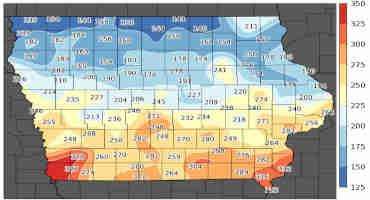
Fields south of Interstate 80 in Iowa should be scouted beginning at 200 GDD and fields north of Interstate 80 should be scouted beginning at 250 GDD. If plants are tall enough, use a sweep net to detect larvae (Photo 1), then systematically sample fields to determine larval numbers and plant height. If plants are growing slowly and are too short to sweep, check plants for alfalfa weevil larvae beginning at the terminal leaflets. This encyclopedia article details alfalfa weevil identification and provides a scouting plan as well as information on economic thresholds for making treatment decisions.
Keep in mind that the economic threshold tables were developed based on healthy stands with plants 10-12 inches tall. If an alfalfa field is experiencing signs of stress from recent drought conditions or past pest issues, be on the conservative side of the ET tables when making treatment decisions. Early cutting is preferred to chemical treatments, especially when plants are at least 16 inches tall, but insecticides may be used if early harvest is not an option. The first cutting is at the greatest risk for alfalfa weevil feeding injury (Photo 1).
.jpg)
Be aware! Recently, entomologists and agronomists have observed more early-season injury to alfalfa stands and prolonged feeding by alfalfa weevil (sometimes after the first cutting). Typically, adults move to sheltered areas during the summer and remain there to overwinter. However, during warm autumns and mild winters, alfalfa weevil adults may become active and lay eggs. The overwintering eggs hatch earlier in the spring than our degree day models predict (developed based on adult activity in the spring), thus people may observe earlier and prolonged feeding in alfalfa. Continue to scout after the first cutting!
Source : iastste.edu