By Jeff Mulhollem
Dairy farms -- especially in the Northeast -- are increasingly subject to more stringent regulations to reduce nutrient losses. With expected warmer conditions that will result in increased ammonia volatilization from manure and more frequent and more severe storms that will cause more soluble phosphorus runoff, new strategies such as manure injection (shown) are needed to limit nitrogen and phosphorus losses from crop fields. Credit: Robert Meinen and Heather Karsten
Dairy farmers in the Northeast-- facing a warming climate that exacerbates nutrient pollution but lengthens the growing season--can reduce the environmental impact of their operations and maximize revenues by double cropping and injecting manure into the soil, rather than broadcasting it.
That's the conclusion of a team of researchers, led by Penn State agroecologists, whose new study evaluated whole-farm production and the environmental and economic impacts of adopting these practices on a representative dairy farm in central Pennsylvania under recent historical and projected midcentury climate.
The research is important, according to Heather Karsten, associate professor of crop production/ecology in the college, because dairy farms--especially in the Northeast--are increasingly subject to more stringent regulations to reduce nutrient losses. With expected warmer conditions that will result in increased ammonia volatilization from manure and more frequent and more severe storms that will cause more soluble phosphorus runoff, new strategies are needed to limit nitrogen and phosphorus losses from crop fields.
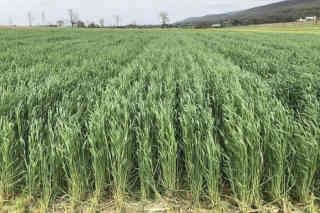
The researchers found that double cropping increased and stabilized the farm's feed production by providing forage from a winter rye crop (shown) with less dependency on the summer crops of corn silage and perennial cool-season grasses.
"We have been trying to identify how to help dairy farms be profitable and produce more of their feed and forage crops while at the same time ease the challenges of nutrient management," she said. "Double cropping small grains such as winter wheat or winter rye and corn silages provides a strategy that can benefit dairy farms in the northeastern U.S. as they take advantage of a longer growing season. Also, subsurface application of manure may reduce nutrient losses as the region faces warmer temperatures and greater precipitation."
To reach their conclusions, the researchers simulated farm management strategies using the Integrated Farm System Model developed by C. Alan Rotz, an agricultural engineer with the U.S. Department of Agriculture's Agricultural Research Service. The strategies were informed by a long-running, dairy cropping systems experiment at Penn State's Russell E. Larson Agricultural Research Center, supported by USDA.
That simulation enabled the scientists to determine the effects on crop yields, feed production, nitrogen losses, sediment erosion, sediment-bound and soluble losses of phosphorus, greenhouse gas emissions, fossil energy use, and production costs.
In findings published in Agricultural Systems, the researchers reported that double cropping and subsurface injection of manure reduced total nitrogen losses by 12 to 18 percent and total phosphorus losses by 16 to 19 percent. Adoption of these strategies, they noted, provided a feasible adaptation and mitigation approach for future climate change by reducing projected increases in soluble phosphorus runoff and ammonia emissions caused by warmer temperatures and greater precipitation.
Significantly, these benefits can be achieved while maintaining and potentially reducing total farm-production costs, Karsten pointed out.
Source : psu.edu