By Myat Thida Win and Zachariah Rutledge
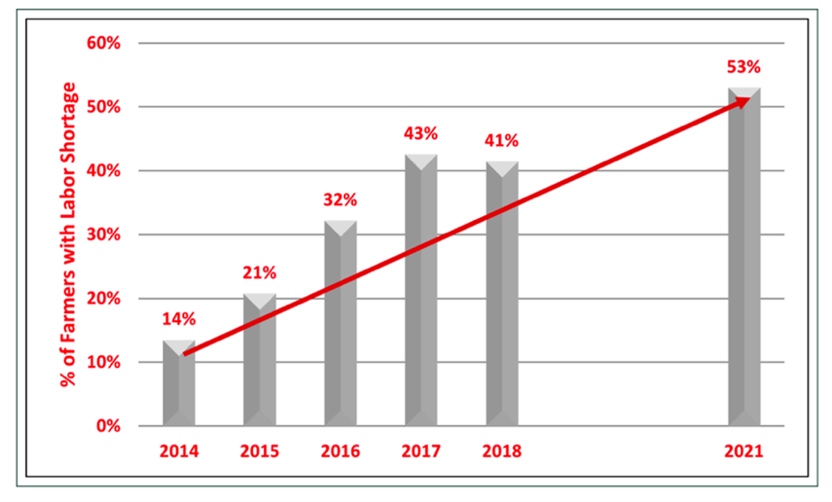
Over the past two decades, U.S. farmers have experienced persistent labor shortages (Figure 1). A sharp decline in immigration, rising education levels in the U.S. and abroad, increased competition from non-farm sectors, and the aging of foreign-born farmworkers are among the key forces driving this trend. Although farm wages have risen faster than wages in much of the broader economy, these increases have not been sufficient to attract a large enough domestic workforce into seasonal, physically demanding agricultural jobs.
The H-2A program provides a legal pathway for U.S. agricultural employers to hire seasonal foreign workers when domestic labor is not available. As the supply of U.S. farmworkers continues to decline, the program has become a critical part of the agricultural workforce.
Michigan mirrors national trends. The state produces many labor-intensive specialty crops — such as apples, blueberries, cucumbers, squash and asparagus — that require a large workforce during short, time-sensitive harvest periods. In 2024, Michigan farms employed about 15,000 H-2A workers, underscoring the program’s essential role in sustaining the state’s agricultural production.
Background on the H-2A Visa Program
The H-2A visa program was established in 1986 to allow foreign workers to enter the U.S. temporarily for low-skilled, seasonal agricultural jobs. Under this program, farm employers may hire foreign workers for seasonal agricultural work — typically up to 10 months — under the following conditions:
- Employers must demonstrate that they cannot find sufficient domestic workers.
- Workers must leave the U.S. when their visas expire.
- Jobs must be seasonal, which excludes year-round industries such as dairy.
- Employers must provide free housing for H-2A workers.
- Employers must pay for workers’ transportation between their home country and the work site.
- Employers must pay the Adverse Effect Wage Rate (AEWR), a special minimum wage intended to ensure that hiring foreign workers does not negatively impact U.S. farmworkers.
These requirements mean that H-2A workers are often more expensive than domestic workers once housing, transportation, and application costs are included. Recent research estimates that total H-2A employment costs are 20% to 50% higher than hiring U.S. workers, including unauthorized workers who have settled in the U.S. according to Castillo, Martin, and Rutledge, 2024.
Surge in the use of the H-2A Visa program in Michigan
Michigan agriculture depends heavily on seasonal labor, especially in fruit, vegetable, and nursery production. H-2A workers fill essential roles in harvesting, pruning, packing and field tasks during peak seasons.
Use of the H-2A program has grown rapidly in the state (Figure 2). Michigan had less than 1,000 certified H-2A positions in FY 2008, but by FY 2024, that number had increased to over 15,000.
Source : msu.edu