By Lucas Haag
Spring wheat is a cool-season grain crop that in adapted areas of production (typically the Northern Great Plains) usually produces a higher protein and higher quality grain for milling and baking purposes. Spring wheat can be produced in northwest Kansas and adjoining areas. We know that yields will be lower than summer fallow winter wheat or stubble-back (continuous) winter wheat, but may be comparable to winter wheat late planted into row-crop stalks. Grain quality will be an important component of marketability. The long-term ability to produce quality spring wheat in northwest Kansas, and its economic viability, has yet to be demonstrated but we continue to see producers in northwest and north-central Kansas giving it a try.
Management factors
Traditionally, spring wheat has not been a recommended crop in northwest Kansas. However, if spring wheat is planted, the K-State recommendation is to plant from February 25 through March 15. Particular emphasis should be given to the ending date as it relates to minimizing heat stress, which will be the yield limiting factor in most years. In research plots at Colby, dormant seeded spring wheat in December has shown to be viable in stand establishment. Seeding rates higher than those typically used in winter wheat will be necessary due to the reduced window for initiating productive tillers. In addition, heat stress will be exceptionally detrimental to tillers of spring wheat as compared to winter wheat, making the density of main stems even more important to achieving yield potential.
The northwest extension agronomy program at K-State has conducted several site -years of seeding rate trials in spring wheat. Responses have generally been flat (Figure 1), this is not entirely surprising at the low yield levels experienced. Based on this limited data and experience, we would recommend 1.3 to 1.8 million seeds per acre to be an appropriate range. We are continuing to conduct seeding rate trials at locations in Kansas and are collaborating with scientist at the University of Nebraska in identifying appropriate spring wheat seeding rates for the central Great Plains region. With respect to nitrogen management, growers should consult the recommendations offered by North Dakota State University in the publication SF712, “Fertilizing Hard Red Spring Wheat and Durum”. Spring wheat will reach physiological maturity and be harvested slightly later than winter wheat in our region.
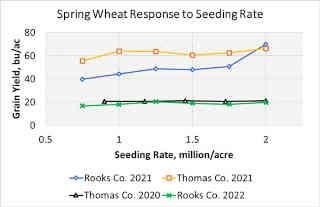
Figure 1. Spring wheat yield response to different seeding rates for locations in northwest Kansas. Graph by Lucas Haag, K-State Research and Extension.
Experimental data on yield of spring wheat
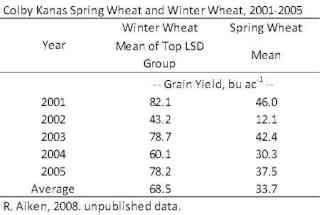
Spring wheat has been evaluated at several points in time in northwest Kansas. From a historical context, during a 35-year study at Colby (1915-1950), spring wheat grown on fallow averaged slightly less than ½ of winter wheat grown (also on fallow). Additional research in the 1970’s demonstrated a similar relationship. More modern research was conducted in 2001 through 2005 in which spring wheat averaged 49% of winter wheat (Table 1).
Table 1. Summary of grain yields for spring wheat vs. winter wheat from 2001-2005 at Colby, KS.
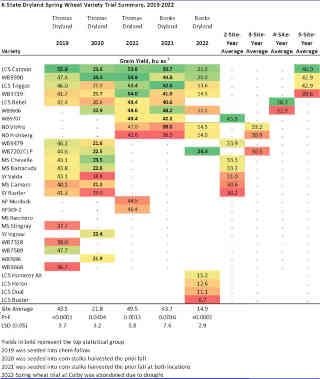
In response to producers’ questions regarding spring wheat, spring wheat variety trials were conducted in northwest KS beginning in 2019. Table 2 shows individual year and across-years means for spring wheats evaluated at Colby, Kansas. There is a distinct difference in yields between the two years. The first year of the trial was seeded into chem-fallow ground while the second year of the trial was seeded into fresh corn stalks harvested the prior fall. While adequate stands were attained in both years, the cooler temperatures during grain fill and increased soil moisture due to the previous fallow period resulted in greater yield potentials in 2019.
Table 2. Across-years yield performance for spring wheats evaluated at Colby, Kansas, 2019-2022.
Data would show a significant reduction in yield potential for spring wheat relative to winter wheat when both are grown on fallow. Yields are likely to be more similar when grown immediately following a row crop. It is important to note however, yield is not the lone determining factor for the viability of the practice. Differences in cost structure and revenue could very well make spring wheat an economically feasible fallow alternative, provided that quality grain can be raised and marketed at a premium to winter wheat.
Marketing
Producers should be aware that hard red and hard white spring wheats are different market classes than hard red or hard white winter wheats. While small quantities are likely being blended off without notice, any concentration greater than 2% would be considered a mixing of classes that could result in the rejection of shipments. A local delivery point has received spring wheat northwest Kansas for the past several years. Additionally, a producer may have success using on-farm storage to allow proper segregation, time to perform necessary testing of grain quality, and then direct marketing to a mill.
Take home message
Spring wheat can be produced in this region. Producers should have marketing plans in place prior to production and manage the crop to ensure quality. Yields will likely be less relative to winter wheat due to heat stress during grain fill. However, there are still many unknowns regarding the production of spring wheat and its long-term viability in northwest Kansas and adjacent areas.
Spring wheat variety performance test results are available to download on the Northwest Area Agronomy website: www.northwest.ksu.edu/agronomy
Source : ksu.edu