Farms.com Home   News

Is the Renewable Diesel Boom Done?

A recent Tidbits article took note of the sizable growth in Nebraska’s soybean processing capacity in progress. The driving factor in the growth is the explosive demand for soybean oil for producing renewable diesel. Renewable diesel can replace petroleum diesel gallon-for-gallon and is less carbon intensive than petroleum diesel. With state and federal policies mandating and incenting low carbon fuels, the demand for renewable diesel has boomed. At the federal level, the renewable fuel standard (RFS), blender tax credit of $1.00/gallon, and tariffs on imports of biodiesel have sparked demand. And low carbon fuel standards (LCFS) adopted by California, Oregon, and Washington mandating the use of low carbon fuels have added fuel to the demand fire. The LCFS in California is especially key. Scott Gerit, chief economist for the American Soybean Association, says 97 percent of the country’s renewable diesel consumption occurs in California.

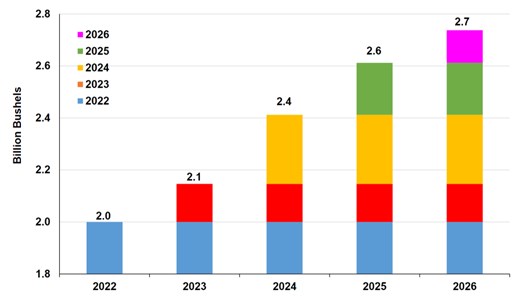
As a result, renewable diesel refining capacity has grown phenomenally since 2020 (Figure 1). Refining capacity amounted to 800 million gallons in 2020 and grew to in excess of 4 billion gallons last year. It is expected to surpass 7 billion gallons later this decade. Consequently, soybean crush capacity has also grown (Figure 2). Capacity last year had grown to 2.1 billion bushels, and it is expected to expand an additional 600 million bushels by 2026.  

FIGURE 1. RENEWABLE DIESEL NAMEPLATE PRODUCTION CAPACITY
crop

FIGURE 2. CURRENT & EXPECTED SOYBEAN CRUSH CAPACITY
crop

Click here to see more...

Trending Video

Democratizing Gene Editing - Pairwise’s Vision for the Future of Agriculture

Video: Democratizing Gene Editing - Pairwise’s Vision for the Future of Agriculture

Pairwise has built its business around an idea that runs counter to how many companies approach innovation: make transformative technology easier to access.

In this Seed World interview, CEO Tom Adams discusses why broader access to gene editing could speed crop improvement, expand innovation opportunities and help agriculture address emerging challenges. He explains why Pairwise believes no single company can solve all of agriculture's problems alone—and why making advanced breeding technologies available to more organizations could accelerate progress across the industry.

The conversation explores how consumer trust influences technology adoption, why innovations like pitless cherries and seedless blackberries matter beyond convenience, and how future crop improvements could help address labor shortages, automation, harvest efficiency and other production challenges. Adams also shares his perspective on what the industry may be underestimating about the next wave of gene editing innovation.

Watch the full interview to hear why Pairwise believes agriculture is approaching an important inflection point for gene editing, and why the pace of innovation over the next decade could surprise the industry.

Topics Covered:

o Democratizing agricultural innovation

o Consumer trust and technology adoption

o The business case for sharing innovation

o Expanding innovation beyond major crops

o Next-generation breeding technologies