By Christine Gelley
Poison hemlock has already emerged in a vegetative state around Noble County and beyond. Soon it will be bolting and blooming on stalks 6-10 feet tall. All parts of the plant are toxic to all classes of livestock if consumed and is prevalent along roadsides, ditches, and crop field borders. It is a biennial weed that does not flower in the first year of growth but flowers in the second year. The earlier you can address poison hemlock with mowing and/or herbicide application, the better your control methods will be.
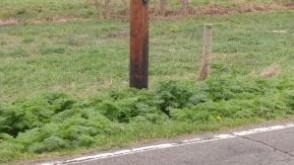
Poison hemlock is a concern in public right of ways, on the farm, and in the landscape!
Poison hemlock is related to Queen Anne’s lace, but is much larger and taller, emerges earlier, and has purple spots on the stems. Another relative that is poisonous is wild parsnip, which looks similar to poison hemlock, but has yellow flowers. Giant hogweed is another relative of poison hemlock that is also toxic. All of these plants have umbel shaped clusters of flowers.
According to Joe Boggs of OSU Extension, “Poison hemlock plants contain highly toxic piperidine alkaloid compounds, including coniine and gamma-coniceine, which cause respiratory failure and death in mammals. The roots are more toxic than the leaves and stems; however, all parts of the plant including the seeds should be considered dangerous. The toxins must be ingested or enter through the eyes or nasal passages to induce poisoning; they do not cause skin rashes or blistering. Regardless, this plant should not be handled because sap on the skin can be rubbed into the eyes or accidentally ingested while handling food.”
Treatment for poison hemlock includes aggressive mowing to prevent flowering and seed production or herbicide application. Some commonly available herbicides that are generally effective on this weed include glyphosate, 2, 4-D, Remedy Ultra, and Crossbow. All treatment methods are most effective when employed while plants are less than 2 feet tall.
Don’t let poison hemlock gain ground on your property this season! If you see it, take steps to eliminate it. Learn more about poison hemlock identification, concerns, and control by watching the following video by OSU Extension on YouTube.
Source : osu.edu