Many producers could not apply N fertilizer in the fall due to the persistent saturated soil conditions, with wet conditions continuing for many soils this spring. Corn planting has already begun in south eastern Kansas. As planting time for the rest of the state rapidly approaches, producers may have questions related to the potential effect of ammonia (NH3) to corn seedlings, as well as soil considerations for anhydrous ammonia applications under suboptimal conditions.
Figure 1. Field application of anhydrous ammonia. Photo by Stu Duncan, K-State Research and Extension.
Soil factors related with anhydrous ammonia application
- Chemical – Ammonia (NH3) needs to react with water shortly after application in order to convert into ammonium (NH4+), which is the molecule that can adhere to clay particles and organic matter in the soil. Ammonia is very soluble in water. After it is placed in the soil, NH3 reacts with water in the soil to form ammonium-N (NH4+), which is retained on the soil cation exchange sites. This process takes a little time – it does not occur immediately upon contact with the soil. The main controlling factors in the conversion of NH3 to NH4+ are soil temperature, soil moisture, and soil pH. The higher the soil temperature and the wetter the soil, the more rapid the conversion occurs. Also, equilibrium between NH3 and NH4+ is affected by soil pH. More NH3 will remain unconverted in the soil longer at higher application rates and at higher soil pH levels.
- Physical – Wet soils might not seal properly above the injection slot. This can allow the gas to physically escape into the air before it has a chance to be converted into NH4+. Other issues related to soil compaction can cause significant damage, ultimately reducing the yield potential of the corn crop.
Anhydrous ammonia injury to corn seedlings
Free ammonia (NH3) is toxic to the corn seedling and root system. Visual symptoms typically include root necrosis (death) and plant growth reduction after germination. This potential for injury from spring applications is higher when corn is planted shortly after anhydrous application.
The greatest concentration of ammonia is within the first 1-2 inches of the injection point, and with a typically radius of about 3-4 inches for the overall retention zone for a fine-to-medium textured soil. The size of this zone can vary greatly depending on the N application rate, knife spacing, soil texture, organic matter, soil structure, and moisture. Good soil moisture will help with the conversion to NH4+, potentially reducing the risk of injury to the corn seedling. However, under ideal conditions, waiting 10 to 14 days after ammonia application will allow for adequate time for the convention process. Other alternatives to reduce the risk of injury include managing factors such the planting distance from the anhydrous injection point, planting at an angle to the anhydrous application, and reducing the application rates, particularly on sandy soils (Figure 2).
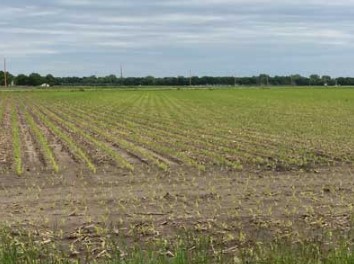
Figure 2. Corn planted at an angle to the anhydrous ammonia application. Photo by Stu Duncan, K-State Research and Extension.
If corn planting can be done at an adequate distance from the anhydrous injection point, the risk of injury will be reduced, and planting can be done sooner after anhydrous application. Producers can also consider a split application of N. This which will allow for a lower N rate applied with anhydrous this spring, with the balance of N applied as side-dress during the growing season. Furthermore, if starter fertilizer will be applied at planting, using either a 2x2 or surface dribble placement, can allow for safe applications of N at planting time (see accompanying eUpdate article in this issue, “Placement and rate considerations for nitrogen application with starter fertilizer”).