Over the last 5-years the Northwest Research Farm near Sutherland, IA has been conducting row spacing by plant population through cultivar trials with two different brands. The trials were not designed to compare brands, but rather provide another comparison to evaluate soybean row spacing and seeding rates. Over time there have been 20 cultivar-year combinations. This gives us an opportunity to look the cumulative data.
The 15-inch soybean row spacing may have a slight numerical advantage over both 20- and 30-inch row spacing, however, across cultivar-years only 2 of 20 were significantly higher yielding at 15-inch row spacing (Figure 1). In those 2 cultivar years, the 15-inch yield advantage was 1.5 to 2.7 bu/ac. When comparing 15- and 30-inch row spacing, there is the appearance of a 15-inch advantage at higher productivity levels (>70 bu/ac) but again this is not a significant effect.
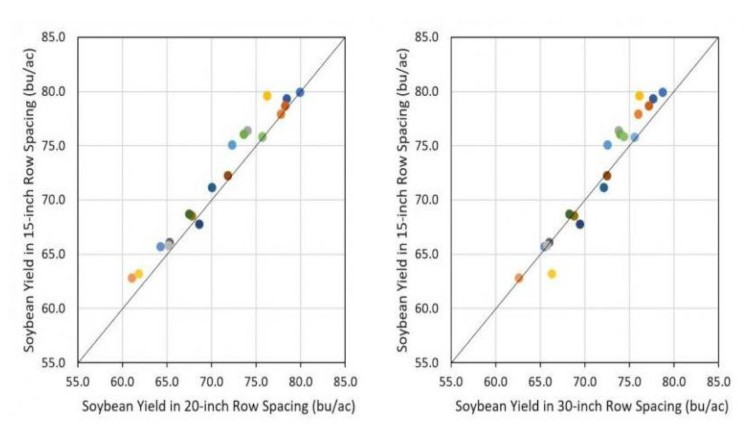
Figure 1. Soybean row spacing comparison with 15-inch row spacing on the vertical axis and either 20-inch (left panel) or 30-inch (right panel) on the horizontal axis. The thin diagonal line represents the 1:1 yield line. The colored points distinguish the 20 cultivar-years from 2016 to 2020 at the Northwest Research Farm near Sutherland, IA.
It is clear that soybean row spacing and plant population are not clear cut decisions for farmers. Unlike corn, soybean have a tremendous ability to compensate for proximity to neighboring plants. For instance, the higher the seeding rate the more seed and plant mortality that occurs through the growing season. This phenomenon is exaggerated at wide rows (greater than 30-inches) compared to narrow rows (15- or 20-inches). However, growing season environment and soybean cultivar characteristics also come into play and should be taken into consideration.
Across all cultivar years there was not an interaction between row spacing and seeding rate (not shown). What does this mean? It means the same row spacing response would be expected regardless of what the row spacing was.
While these results represent one location across multiple cultivars and years, they contrast previous research published for the state of Iowa. In 2018, I wrote an article (Consider 15-inch Row Spacing in Soybean) summarizing past row spacing research in Iowa and talked about the advantages to planting in row spacings narrower than 15-inches. This past research is still valid for Iowa and is comparable to newer research from across the Midwest.
Source : iastate.edu