By Pedro Fontes
While estrus synchronization can eliminate the need for estrus detection, identifying females in estrus can help cattle producers further explore the benefits of technologies such as fixed-time artificial insemination and fixed-time embryo transfer. Research studies performed in different production environments have repeatedly shown that females that express estrus in response to an estrus synchronization protocol achieve greater pregnancy rates compared with females that do not express estrus. In a meta-analysis that compiled data of more than 10,000 inseminations, cows and heifers that expressed estrus prior to fixed-time artificial insemination had 27% greater pregnancy rates compared with females that did not express estrus (Richardson et al., 2016). Similar results are observed in embryo transfer settings. Embryo recipients that express estrus during the synchronization protocol are more likely to successfully establish pregnancy when compared with recipients that ovulate to the synchronization protocol but do not express estrus. Interestingly, cows that express estrus are also less likely to experience pregnancy loss between days 30 and 100 of gestation compared with cows that did not express estrus prior to fixed-time artificial insemination (Pohler et al., 2016).
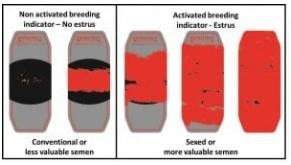
Breeding indicator patches are helpful when target breeding females in a fixed-time artificial insemination program.
Cattle producers can use estrus expression information to make breeding decisions that can maximize their return of investment, even if they are performing artificial insemination and/or embryo transfer using a fixed-time approach. In fixed-time artificial insemination settings, cattle producers can restrict the . . .
Continue reading Taking Advantage of Estrus Expression in Fixed-Time Artificial Insemination
Source : osu.edu