By Chad E. Hart
As is customary, USDA provides the final production numbers for the crops harvested in the fall in January. But along with that report, we also receive updates on quarterly crop stocks and use and the global crop situation. The release of these reports at the same time can be a market moving event. That was definitely the case this year. In the end, USDA found the 2025 corn and soybean crops were the best-yielding crops the US has ever had. Crop plantings exceeded earlier estimates. And prices remain low. Profit opportunities are hard to find once again, with the futures markets showing corn having better prospects than soybeans. Thus, the economic outlook for 2026 remains challenging, continuing the pattern over the past couple of years.
Corn yields
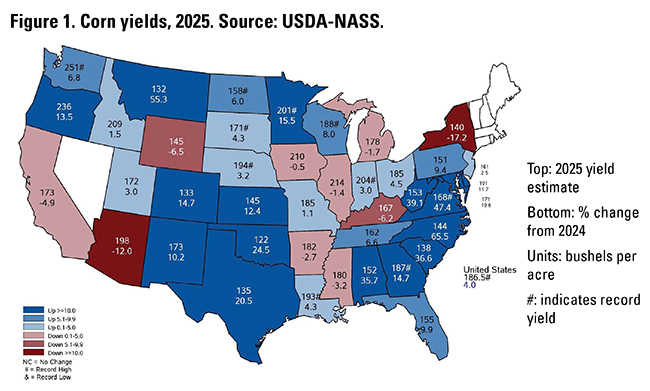
Crop production continues to be strong, despite disease challenges this past year. The January update showed disease pressure in the heart of the Corn Belt, but also the strength in crop production across the entire nation (Figure 1). The final national yield estimate reached a record 186.5 bushels per acre, up 0.5 bushels from the prior estimate, but 7.2 bushel higher than the previous record from 2024. Record yields were established in Washington, North Dakota, South Dakota, Nebraska, Minnesota, Louisiana, Wisconsin, Indiana, Georgia, and Virginia. In November, Iowa and Illinois were projected to reach records as well, but the southern rust and late dryness knocked 6 bushels off from Iowa and 7 bushels from Illinois. But even with those reductions, both states had average yields well above 200 bushels per acre.
Soybean yields
The pattern for soybean yields was somewhat similar. The national yield was a record, despite declining yield estimates in Iowa and Illinois. The national yield of 53 bushels per acre held over from the November estimate and is 2.3 bushels higher than the 2024 crop. Nebraska, Kansas, Minnesota, Iowa, Arkansas, Mississippi, Wisconsin, and Georgia captured record yields. Yield estimates increased across the Great Plains and Southeast. Meanwhile, Iowa’s soybean yield estimate pulled back 1.5 bushels (but still held onto a record level) and Illinois’ estimate fell 2.5 bushels. Combined, the changes left the national yield estimate steady.
Source : iastate.edu