By Rob Sirrine
Petiole testing can help growers dial in plant nutrient needs.
While it is advisable to soil sample each year to determine soil nutrient levels, there is no guarantee that the nutrients present are available for uptake by the hop plant (See Figure 1).

Figure 1. A comparison of petiole vs. soil nitrate levels for hops. Source: Sara Del Moro, 2014 Great Lakes Hop & Barley Conference.
In addition to annual soil tests, tissue testing is a recommended method for determining plant nutrient needs and to help detect potential deficiencies. Hop petioles from mature leaves (5-6 ft. off the ground) should be collected just prior to the plant reaching the wire (likely early July in Northwest Michigan). Petioles should be sent to a tissue-testing laboratory such as the Michigan State University Soil and Plant Nutrient Lab, for nutrient analysis. N,P,K and Magnesium, Calcium, Sodium, Sulfur, Zinc, Copper, Boron, Iron, and Manganese should be measured. If results show deficiencies, foliar nutrients may be applied at that time or granularly applied throughout the year. Figure 2 represents an example of hop petiole complete tissue analysis with low-optimum-high nutrient level ranges. To convert from ppm to lbs/acre multiply ppm x 2 and vice versa (ppm x .5 = lbs/ac).
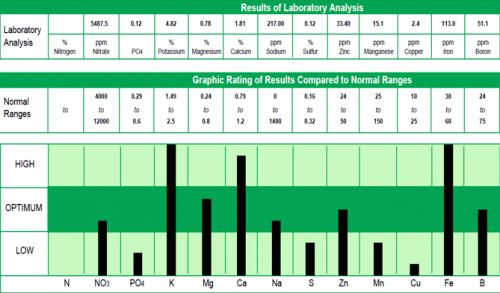
Figure 2. Hope petiole test result examples for macro and micronutrients. Source: Sara Del Moro, 2014 Great Lakes Hop & Barley Conference
Please continue to visit Michigan State University Extension’s hop webpage or the MSU Hops News Facebook site for up to date information. The 9th Annual MSU Hop tour and Field Day registration is now live! Please register as soon as possible-there are limited spaces available.
Source:msu.edu