By Ryan Hanrahan
Progressive Farmer’s Chris Clayton reported that “U.S. farmland values continued to rise this year, with the average value of cropland topping $6,000 for the first time, while pastureland reached $2,000 an acre.”
“USDA (this past) Friday released its annual Land Values Summary report, covering both cropland and pasture. The average value includes not only the value of land but also farm buildings,” Clayton reported. “Overall, farm real estate in the U.S. — cropland and pasture combined — averaged $4,500 per acre this year, up $150 an acre from last year, or about 3.4%.”
“The average value of cropland this year reached $6,020 per acre, up $190 an acre from 2025, or 3.3%,” Clayton reported. “The average value of pasture reached $2,000 an acre, up $80 from last year, or 4.2%. While land values continue to rise, they are doing so at a slower pace than last year. Cropland value rose 4.7% in 2025, while pasture values rose 4.9% last year.”
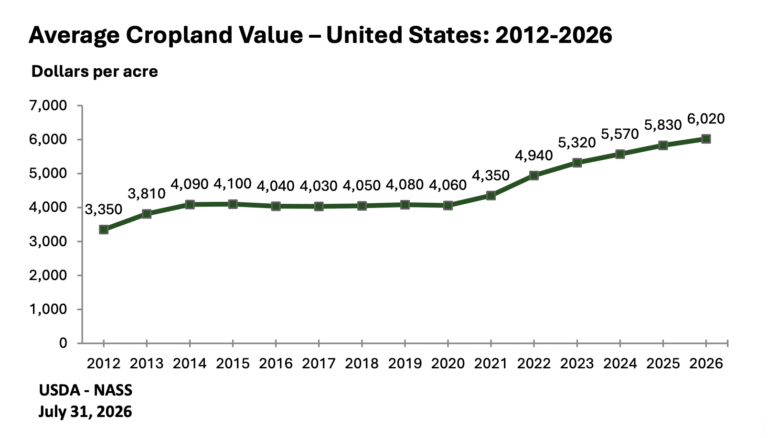
“Since 2022, the average value of cropland has risen from $4,940 per acre nationally to $6,020, a gain of 21.8%,” Clayton reported. “…In the Corn Belt, cropland values in Iowa reached an average of $10,700 per acre, growing by 3.9% (from 2025). Illinois cropland reached $10,200 per acre, rising 3.6%. Ohio’s average cropland value also grew 3.6% to reach $10,100 per acre.”
Source : illinois.edu