Farmers can purchase the Speed-Tiller in 2020
By Diego Flammini
Staff Writer
Farms.com
Cash crop producers looking for more tillage options have one courtesy of Case IH.
The machinery manufacturer is releasing its Speed-Tiller high-speed disk in 2020.
The disk comes in two models: the 465, which is a rigid mounted model, and the 475, which offers a trailing configuration.
The tillage tool can penetrate soil up to six inches deep, helping farmers manage crop residue in the fall and leaving a smooth seedbed for planting in the spring.
“Working 100 percent of the soil profile is really critical to creating an agronomically correct seedbed,” Chris Lursen, tillage marketing manager with Case IH, told Farms.com. “If you run a blade at three inches deep, you would expect that entire profile from soil surface to subsurface is worked.”
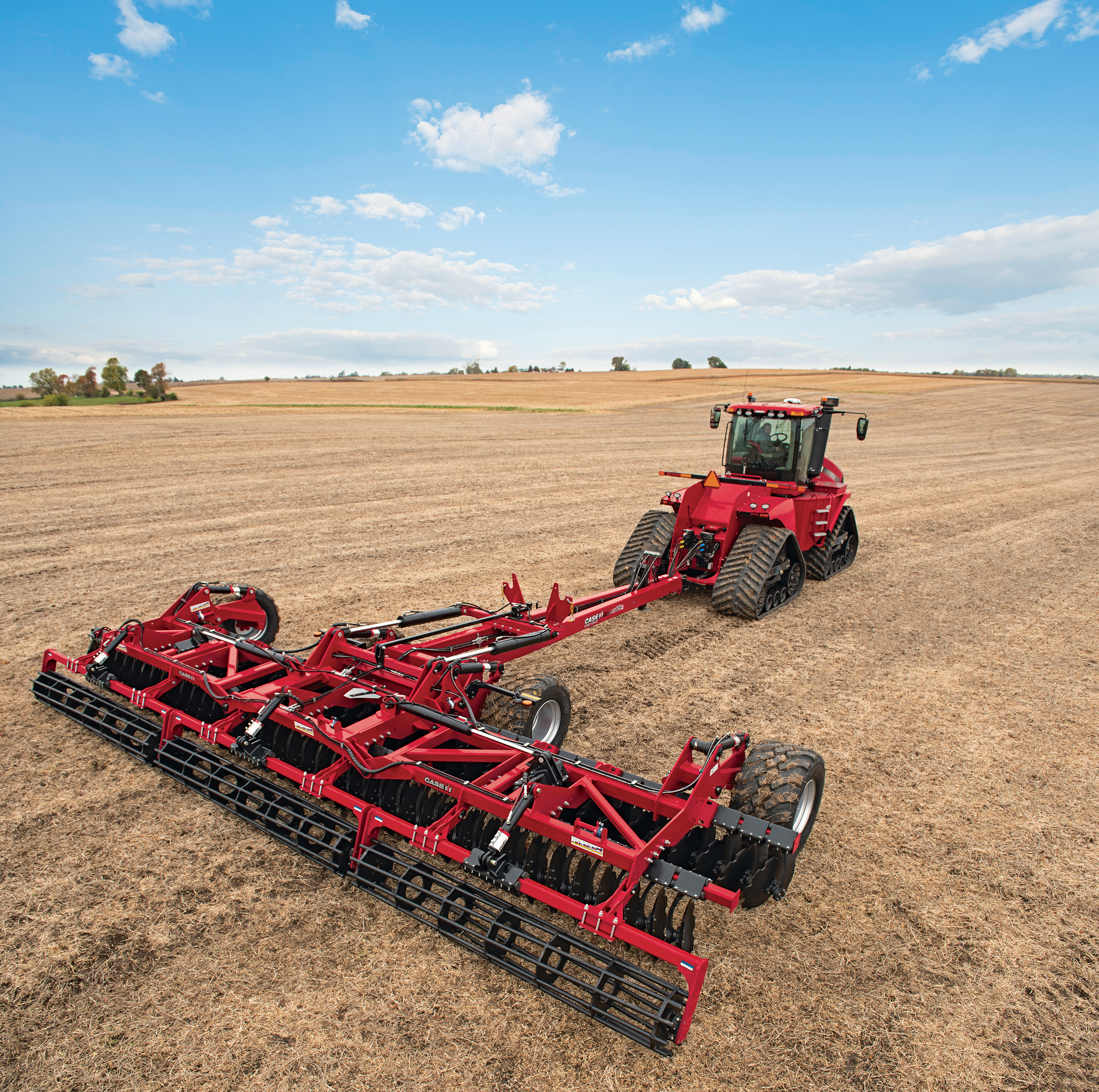
While operating the Speed-Tiller, farmers can adjust the front gang position.
The feature is important for uniform operation, Lursen said.
“It allows the front blades and the back blades to work together to (till) the entire soil profile,” he said. “If they’re not working together, you won’t get a good subsurface floor.”
The disk will also highlight Case IH’s acquisition of K-Line Ag, Australia’s leading tillage equipment manufacturer.
The Speed-Tiller includes some of K-Line Ag’s features to ensure a durable piece of equipment.
“Australia has some of the most rugged and toughest conditions that I have seen,” Lursen said. “The arms that mount the blades are twice as thick as what you’ll see on any high-speed disk. It’s built for aggressive conditions.”