Strong prices raise hopes but herd rebuilding signals remain limited
Cattle prices across North America reached record highs in 2025 as tight supply continued to support the market. Although prices have seen some recent corrections, overall strength remains. High cattle prices, strong feed availability, and declining feed costs are creating optimism across the beef industry.
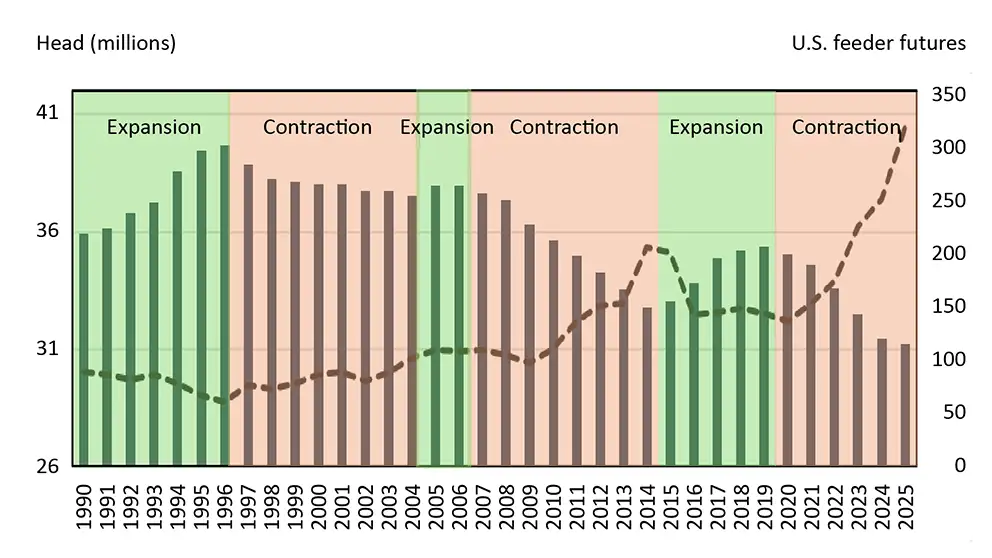
A key question for producers and markets is when cattle herd rebuilding will begin. According to FCC Economics, historical cattle cycles suggest the market is approaching the end of its contraction phase. This stage typically marks the low point of the cycle and signals the early steps toward expansion.
Figure 1.Cow Inventory Dynamics and Feeder Price Responses in the North American Cattle Cycle
Sources: CGC, AAFC, FCC Economics
There are early signs that the Canadian cattle herd may have stopped shrinking. Inventory data from mid-2025 indicates stabilization, supported by fewer Canadian heifers being sent to slaughter. This shift often suggests producers are beginning to retain animals for breeding rather than selling them into the market.
However, the United States remains the main driver of North American cattle supply, and its herd continues to contract. FCC Economics notes that U.S. slaughter levels for cows and heifers have not yet declined enough to clearly indicate that rebuilding is underway. The number of breeding animals heading to slaughter remains a key indicator to watch, and current data does not yet point to a strong expansion trend in the U.S.
There is still potential for change. Early-year cattle inventory reports in both Canada and the United States will provide important insight into producer intentions. These reports, typically released in late January, offer the first clear signals of heifer retention and changes in cow numbers.
Even if herd rebuilding begins in 2026, it will start from historically low levels. The North American cattle herd remains at its smallest size in decades. As a result, FCC Economics says supply will remain tight for some time, limiting rapid growth in cattle numbers.
Because of this slow recovery, cattle prices are expected to stay elevated. According to FCC Economics, prices should remain well above the five-year average through 2026, supported by limited supply, improving feed conditions, and ongoing demand for beef.
Photo Credit: istock-123ducu