The move comes after horses there tested positive for vesicular stomatitis
Some shipments of Canadian hogs, horses, and other livestock returning to Canada from the U.S. are suspended indefinitely.
A note from the Canadian Food Inspection Agency to exporters says it took this action after horses on two separate premises in Arizona’s Cochise County tested positive for vesicular stomatitis (VS) in October.
VS resembles foot and mouth disease.
Symptoms of VS include mild fever and blisters or lesions around the mouth, nose, or even above the hooves.
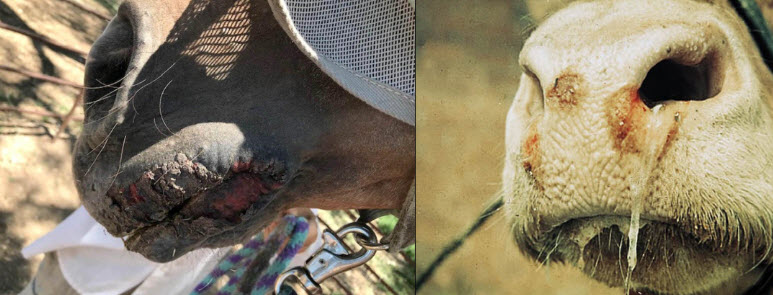
Vesicular stomatitis on the left, and food and mouth disease on the right. (North Dakota Department of Agriculture photos.)
Affected animals may be unwilling to eat or drink. Hogs may become lame and dairy cattle should show a decrease in milk production.
The disease is spread through insects like midges and black flies, or through contact with saliva or fluid from lesions of affected animals.
Canadian animals can return to Canada from the U.S. if specific protocol is followed.
Animals “returning on their Canadian health certificate can do so up to three days after the state they are in has been declared affected by vesicular stomatitis by USDA and must be inspected by the CDIA POE (port of entry) vet,” the CFIA’s note says.
Otherwise, an animal in a state infected with VS must be moved to a non-infected state and stay there for at least 21 days.
“If the only route available is through a VS affected state, when the owner/shipper arrives at the Canadian port of entry they must complete a Supplementary Declaration,” the CFIA says.
The USDA and CFIA arranged special exemptions for animals coming into Canada for events like the Calgary Stampede, Agribition and the Royal Winter Fair.
Canada’s last case of VS occurred in 1949.
The disease “was reported in ten counties of Wisconsin and later in Minnesota and over the Canadian border,” the Centre of Agriculture and Bioscience’s digital library says.