Farms.com Home   Ag Industry News

China won’t increase import quotas on some crops

China won’t increase import quotas on some crops

The U.S. and China are slated to sign a phase one trade agreement next week

By Diego Flammini
Staff Writer
Farms.com

Chinese officials aren’t saying which commodities the country will increase its imports of in order to meet trade figures with the U.S.

What the Chinese are disclosing, however, is which import quotas they won’t touch in order to increase their American ag purchases.

China’s annual quotas for wheat, rice and corn are 9.64 million metric tonnes (mmt), 7.2 mmt and 5.32 mmt, respectively, and the country has no intention of increasing these purchases.

“These are global quotas. We will not adjust them just for one country,” Han Jun, vice-minister of agriculture and rural affairs, told Caixin, a Chinese financial news site, CNBC reported.

Chinese market analysts had projected U.S. crop import figures under the phase one trade deal. The two countries are scheduled to sign said agreement on Jan. 15 in Washington, D.C.
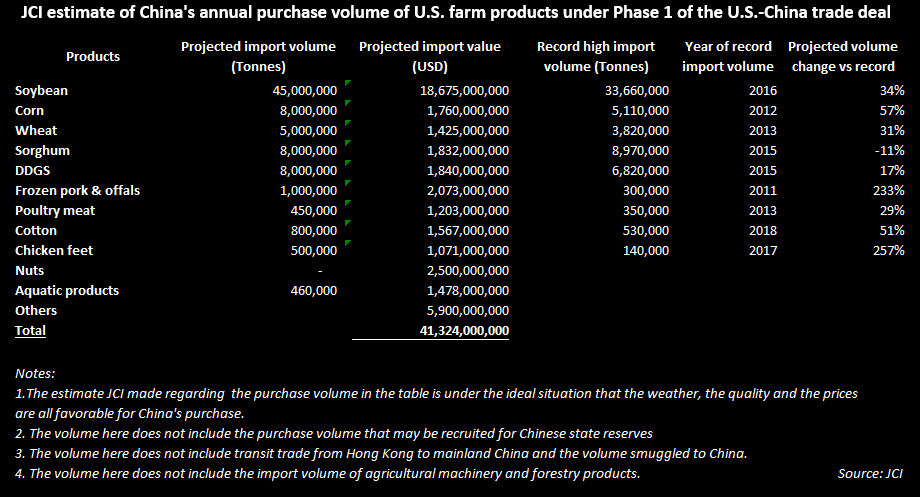
Those annual numbers sat around 8 mmt for corn, worth about US$1.76 billion, and 5 mmt for wheat, worth around US$1.42 billion, JCI Intelligence, a Chinese analyst, said in December.

China’s decision not to raise import quotas raises some worries.

“It’s a concern because it puts into question whether China can import those amounts,” said Moe Agostino, chief commodity strategist with Farms.com Risk Management. “The Chinese could use past tariff-rate quotas that have been unfulfilled to hit those targets.”

China’s decision hasn’t affected market prices, though.

Markets are waiting until Friday’s USDA crop reports come out, Agostino said.


Trending Video

How farmers are protecting the soil and our food security | DW Documentary

Video: How farmers are protecting the soil and our food security | DW Documentary

For a long time, soil was all but ignored. But for years, the valuable humus layer has been thinning. Farmers in Brandenburg are clearly feeling the effects of this on their sandy fields. Many are now taking steps to prepare their farms for the future.

Years of drought, record rainfall and failed harvests: we are becoming increasingly aware of how sensitively our environment reacts to extreme weather conditions. Farmers' livelihoods are at stake. So is the ability of consumers to afford food.

For a few years now, agriculture that focuses solely on maximum yields has been regarded with increasing skepticism. It is becoming more and more clear just how dependent we are on healthy soils.

Brandenburg is the federal state with the worst soil quality in Germany. The already thin, fertile humus layer has been shrinking for decades. Researchers and farmers who are keen to experiment are combating these developments and looking for solutions. Priority is being given to building up the humus layer, which consists of microorganisms and fungi, as well as springtails, small worms and centipedes.

For Lena and Philipp Adler, two young vegetable farmers, the tiny soil creatures are invaluable helpers. On their three-hectare organic farm, they rely on simple, mechanical weed control, fallow areas where the soil can recover, and diversity. Conventional farmer Mark Dümichen also does everything he can to protect soil life on his land. For years, he has not tilled the soil after the harvest and sows directly into the field. His yields have stabilized since he began to work this way.

Isabella Krause from Regionalwert AG Berlin-Brandenburg is convinced after the experiences of the last hot summers that new crops will thrive on Brandenburg's fields in the long term. She has founded a network of farmers who are promoting the cultivation of chickpeas with support from the scientific community.