Farms.com Home  › Ag Industry News

Farm groups urge for quick Vilsack confirmation

Farm groups urge for quick Vilsack confirmation

Several industry organizations signed a letter addressed to the Senate ag committee

By Diego Flammini
Staff Writer
Farms.com

Several farm industry groups are asking federal officials to confirm the next secretary of agriculture without delay.

Nearly 130 signatories including the American Farm Bureau Federation, Agricultural Retailers Association, National Pork Producers Council and National Corn Growers Association sent a letter to the Senate agriculture committee to “respectfully urge confirmation of the Honorable Thomas Vilsack to serve as Secretary of Agriculture,” the Jan. 20 letter states.

Vilsack served as head of the USDA for eight years under President Obama and was the president and CEO of the U.S. Dairy Export Council since 2017 before receiving President Biden’s nomination.

His experience working in and with the ag sector make him worthy of a quick confirmation process.
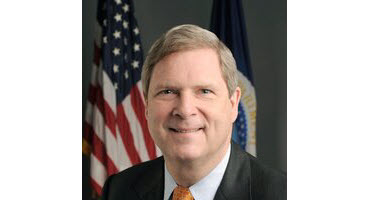
Tom Vilsack

“We endorse the nomination of Secretary Vilsack not just because of his previous outstanding eight-year tenure in the post during the Obama Administration, but more importantly because of his vision for meeting the substantial current challenges of food and agriculture,” the groups wrote.

The confirmation process will require Vilsack to undergo questioning from the Senate ag committee.

It can sometimes take an extended period of time to confirm a candidate, but that likely won’t be the case for Vilsack, said Ryan Bernstein, a senior policy advisor with McGuireWoods, an organization representing food and agribusiness interests.

“In 2017, Secretary Perdue didn’t clear until April 24 (after his March 23 hearing),” Bernstein told Farms.com. “I don’t anticipate it taking very long for Secretary Vilsack. The only question is if they have to take a formal vote or if he’s unanimously approved again.”

Bernstein is also a former chief of staff for North Dakota Senator John Hoeven and worked with members of the Senate on recent farm bills.

To date, only one of President Biden’s Cabinet picks have received confirmation.

On Jan. 20, the Senate confirmed Avril Haines as the director of national intelligence by a vote of 84 to 10.


Trending Video

The 15-Year Bet Behind Every New Variety

Video: The 15-Year Bet Behind Every New Variety!


Canada is trying to decide how much agricultural research capacity it can afford to lose. Brian Rossnagel believes the better question is whether the country can afford to rebuild it.

The longtime barley and oat breeder makes the case with a simple fact about his profession: the consequences of today’s decisions may not become visible for 10 or 15 years.

“Pick the right parents. That’s the biggest thing,” Rossnagel says. “If you pick the wrong parents, you’re not going to get anywhere—and you don’t know that until 10 years, 15 years later.”

That warning carries particular weight as Agriculture and Agri-Food Canada moves to reduce spending and streamline parts of its science operations. The department’s 2026–27 plan anticipates the loss of approximately 665 positions by 2028–29 and says some research will be reduced where capacity exists in academia or industry. AAFC says the changes will make its science operations more cost-effective over the long term.

For Canada’s seed industry, Rossnagel’s career illustrates what is at stake.

This fall, the retired University of Saskatchewan breeder will be inducted into the Canadian Agricultural Hall of Fame. During his 35-year career at the Crop Development Centre, he helped develop more than 100 barley and oat varieties, including CDC Austenson—one of Western Canada’s most widely grown feed barleys. His induction recognizes not only those varieties, but the collaboration and research system that made them possible.

Rossnagel is quick to emphasize that none of it was the work of one person.

“The first thing I thought about was all the other people who contributed to whatever success I and my program had over the years,” he says. “We know that it’s not an individual who does this. It’s a group—a team.”

That team extends well beyond the breeder whose name appears beside a variety. It includes technicians, pathologists, quality specialists, statisticians, regional testing sites, seed growers and industry partners. It also includes the breeders who came before and those who will carry the germplasm forward.

CDC Fraser barley, for example, moved through three breeding careers. Its parents came from Brian Harvey’s program. Rossnagel advanced the material after Harvey retired, and Aaron Beattie later guided it through registration and release.

That kind of handoff is normal in plant breeding. The person who makes the original cross may never see the resulting variety reach farmers.

It also explains why lost research capacity cannot simply be switched back on when budgets improve.

“If you shut it off, it’s very, very difficult—and particularly costly—to start it up again,” Rossnagel says. “If you have to start from scratch, it’s going to be at least 10 years before anybody notices whether you’re getting anything done or not.”

The concern is not simply how many experimental lines Canada can process. Modern equipment, statistical tools and genetic technologies allow today’s breeding programs to evaluate tens of thousands of lines—far more than Rossnagel could handle when he entered the field in the early 1970s.

But efficiency and automation do not generate every idea.

“If you pare back down, and instead of having six or seven individual scientists concentrating on wheat breeding, you go down and say three people could handle all this, well, that’s half the ideas gone,” he says. “Particularly if you happen to lose the three people who had the really neat and innovative ideas, boy, that’s a problem.”

It is a timely distinction for Canadian agriculture. Consolidating programs may preserve the volume of material moving through a system, at least initially. It may not preserve the diversity of thinking, regional knowledge or willingness to pursue unconventional crosses.

That regional knowledge matters because Canadian agriculture is not one uniform production environment. A variety suited to southern Alberta may face different disease, moisture and maturity pressures than one grown in Manitoba, Ontario or Atlantic Canada.

“Agriculture is applied biology,” Rossnagel says. “Biology, all around the Earth, moves from the poles to the equator. It does not move from Newfoundland to B.C. like politics do.”