Device can take various plant measurements
By Diego Flammini
Assistant Editor, North American Content
Farms.com
A device developed by a Kansas State University (KSU) student can help give farmers an idea about their plants’ health, similar to how devices like ‘FitBit’ do so for humans.
The Phenocart, developed by Jared Cain, can capture essential plant data including vital signs, growth rate and color, the same way some personal devices can measure blood pressure.
The device performs phenotyping – which is knowing what physical traits a plant has. Kansas State University researchers who used the tool during a large field experiment said it's a more efficient way to collect the necessary data.
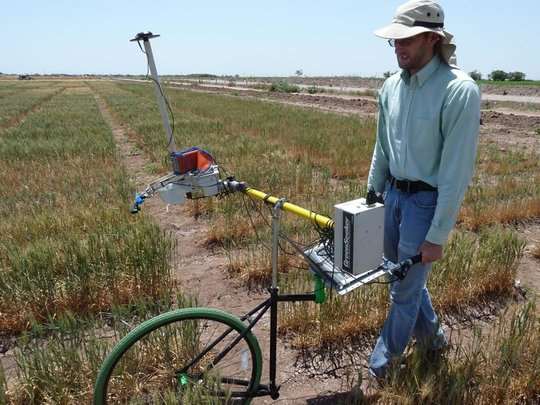
Kansas State University student and Phenocart developer Jared Cain collects data in drought stress wheat trials.
Photo by Mariano Cossani
"Measuring phenotypes is very labor-intensive, and really limits how big of an experiment we can do,” said Jesse Poland, assistant professor in KSU’s Department of Plant Pathology and Agronomy, in a release. “The new tool will allow for faster measurements and accelerate the breeding process.”
The Phenocart is an array of sensors attached to a repurposed bicycle wheel and handles that allows for easy movement within the fields.
It can be outfitted with different sensors depending on what’s being measured, including leaf temperature, vegetation index and GPS. The Phenocart software package can process the data.
Poland said one of the device's best qualities is its portability. The research team is also looking at making the technology available to broader audiences.