Rising input costs and trade uncertainties are forcing U.S. farmers to rethink their planting plans for the season.
With all the market uncertainty lately, farmers have some tough choices to make.
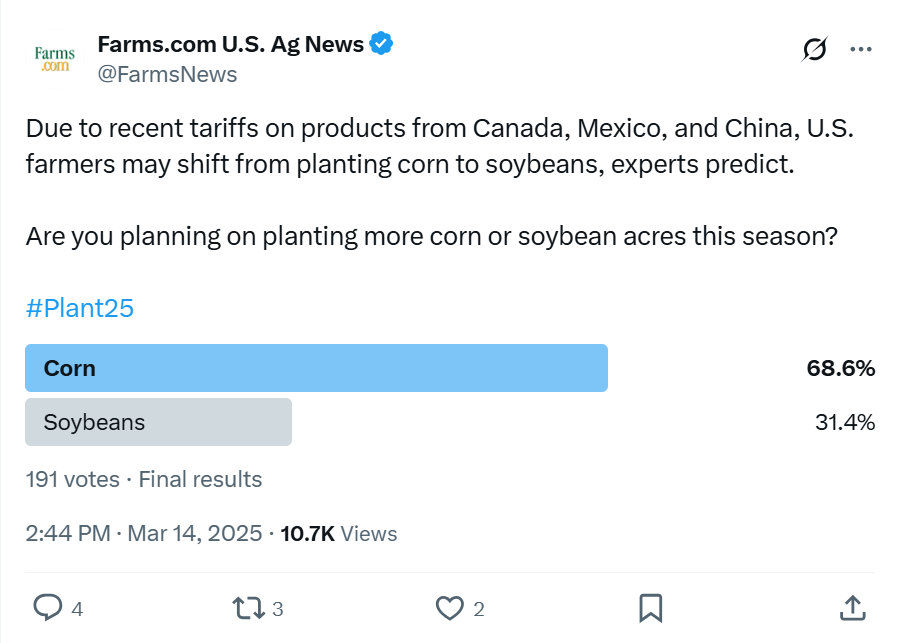
A recent poll done on Farms.com's X account (@farmsnews) asked growers if they’re planning to plant more corn or soybeans this season, especially with the latest tariffs on products from Canada, Mexico, and China.
The results showed that 68.6% are planning on more corn while 31.4% are leaning toward soybeans, but there’s a lot more to this decision than just picking a crop. The poll received 191 votes.
Corn has been the frontrunner for months, with experts predicting the biggest planting year in a while.
Although, these tariffs have thrown a curveball.
They’re not just impacting exports—they’re making everything more expensive, especially fertilizer, which corn requires more of than soybeans, leading some farmers to rethink their game plan.
Prices for key inputs have been climbing, and some reports even suggest fertilizer costs could jump as much as 25%. That’s enough to make anyone take a second look at their options.
Still, the poll suggests that most farmers are staying with corn.
This is likely because corn prices have been decent and remain the foundation of many operations, but the 31.4% shift to soybeans shows that plenty of farmers are carefully weighing the risks.
The corn-to-soy price ratio—something farmers keep a close eye on—has been ticking higher, which usually signals more of a lean toward soybeans.
For those still undecided, it’s a balancing act.
Planting corn means banking on prices staying strong and hoping that input costs don’t eat into profits. Switching to soybeans might mean lower costs upfront, but it also comes with its own market uncertainties.
With planting season just around the corner, we’ll see if the numbers hold or if some farmers make a last-minute pivot.
Right now, the poll shows most are sticking to their plans, but if there’s one thing we know about farming, it’s that nothing is ever set in stone.