Farms.com Home   Ag Industry News

This little Lanark County piggy went with the police

Animal was taken to a local farm

By Diego Flammini
Assistant Editor, North American Content
Farms.com

Under Ontario’s Trespass to Property Act, those found trespassing “(are) guilty of an offence and on conviction (are) liable to fine of not more than $10,000.”

And despite the alleged intruder’s reputation for squealing, a confession of any wrongdoing is doubtful.

According to Ontario Police Reports, Lanark County OPP were called to the 2nd Concession of Dalhousie on Nov. 25 after a resident reported they’d seen a large sow wandering and feeding on their property for three days.

After surrendering to police and being transported to a local farm until its owner can be established, the animal said it got separated from its siblings.
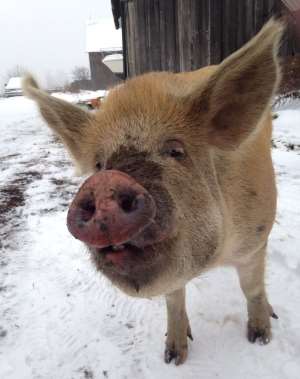

The pig Lanark County OPP transported to a local farm
Photo: OPP

“One of my siblings went to the market, another stayed home,” the pig said. “One went out for roast beef, while another had none. I was scared and tried crying ‘wee wee wee’ all the way home. I must’ve taken a wrong turn.”

No other details about the pig are being released so police can better verify any ownership claims.

Anyone who may have recently lost pigs is asked to call Lanark County OPP at 1-888-310-1122.


Trending Video

Evolution of Beef Cattle Farming

Video: Evolution of Beef Cattle Farming

The Clear Conversations podcast took to the road for a special episode recorded in Nashville during CattleCon, bringing listeners straight into the heart of the cattle industry. Host Tracy Sellers welcomed rancher Steve Wooten of Beatty Canyon Ranch in Colorado for a wide-ranging discussion that blended family history and sustainability, particularly as it relates to the future of beef production.

Sustainability emerged as a central theme of the conversation, a word that Wooten acknowledges can mean very different things depending on who you ask. For him, sustainability starts with the soil. Healthy soil produces healthy grass, which supports efficient cattle capable of producing year after year with minimal external inputs. It’s an approach that equally considers vegetation, animal efficiency, and long-term profitability.

That philosophy aligned naturally with Wooten’s involvement in the U.S. Roundtable for Sustainable Beef, where he served as a representative for the Colorado Cattlemen’s Association. The roundtable brings together the entire beef supply chain—from producers to retailers—along with universities, NGOs, and allied industries. Its goal is not regulation, Wooten emphasized, but collaboration, shared learning, and continuous improvement.