Farms.com Home  › News

2026 Crop Insurance Harvest Prices for Corn and Soybeans

By Nick Paulson and Gary Schnitkey

October settlement prices of Chicago Mercantile Exchange (CME) futures contracts are used to set harvest prices on Federal crop insurance products for corn and soybeans in the Midwest.  Harvest prices are $4.75 per bushel for corn and $12.63 per bushel for soybeans. Both are above their projected prices, which are $4.62 for corn and $11.09 for soybeans.

Because the harvest price is above the projected price for both crops, yield losses will be required to trigger payments under individual and area policies, including Supplemental Coverage Option (SCO) and Enhanced Coverage Option (SCO).  Revenue Protection (RP) sets its guarantee at the higher of the projected or harvest price.  As a result, RP will make higher insurance payments than Revenue Protection with the Harvest Price Exclusion (RP-HPE), which does not have the guarantee increase provision.  Yield Protection (YP) will value covered yield losses at the projected price.

Corn

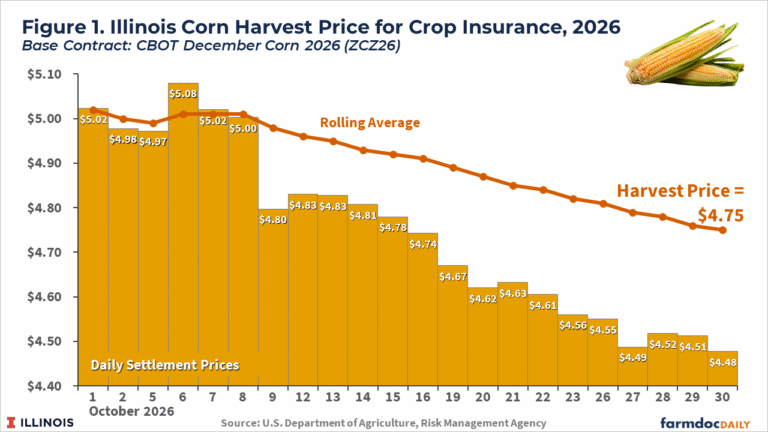
The 2026 harvest price for corn is $4.75, the average of the December 2026 CME corn futures contract during October.  Figure 1 shows daily settlement prices during October and how the average of the settlement prices changed throughout the month.  The December 2026 corn contract started October with settlement prices near $5 per bushel but then declined to around $4.50 by the end of the month. The average of the settlement prices declined to the final harvest price of $4.75 by the end of the month.
Crops

The $4.75 harvest price is $0.13, or 2.8%, above the 2026 projected price for corn of $4.62. As shown in Figure 2, the harvest price for corn was below the projected price in each of the last three years from 2023 to 2025.  Corn’s harvest price exceeded the projected price was during the three consecutive crop years from 2020 through 2022.  Over the last 10 years, from 2017 to 2026, the average difference between the harvest and projected prices for corn has been -$0.09 per bushel.

Source : illinois.edu

Trending Video

From Students to Solutions | On The Brink: Season 2, Episode 14

Video: From Students to Solutions | On The Brink: Season 2, Episode 14

Ask Canada’s most decorated soybean breeder his favourite part of the job and he doesn’t name a single variety. He names the students.

Istvan Rajcan is a professor of soybean breeding and genetics in the Department of Plant Agriculture at the University of Guelph, where he has run the soybean breeding program for 28 and a half years. In that time he has developed 87 soybean cultivars, published 140 refereed papers and trained 51 graduate students. In 2025 he received the Public Sector Impact Award from the National Association for Plant Breeding.

He is also worried. In this episode he says Canada is at a crossroads, pointing to recent government cuts to plant breeding programs and to the facilities that support them. His prescription is structural. "Plant breeding funding formula has to be a long-term one," he says.

The formula he is defending is the public-private matching arrangement his program runs on. Private seed companies fund the work, provincial or federal money matches it, and the combined pool stretches each dollar further than either source could alone. At the National Association for Plant Breeding annual meeting in June, he says American public breeders were often surprised at how well that collaboration works in Canada.

He also describes how the people entering plant breeding have changed. His early graduate students came mostly from farms. More recently they include, in his words, "city kids who just became excited about genetics."

Topics covered:

Why public-private plant breeding funding in Canada needs a long-term

commitment rather than a larger one

How matching private seed company investment with provincial and federal

dollars multiplies research capacity

How the graduate student pipeline into plant breeding has shifted from

farm kids to city kids