Research in the college helps shape the apple industry.
One glance at a commercial orchard today and you realize these aren't your grandfather's apple trees. Long gone are the 40-foot-high, widely spaced, gnarled and spindly trees of the past. They've been replaced by squat, tightly planted trees loaded with low-hanging fruit.
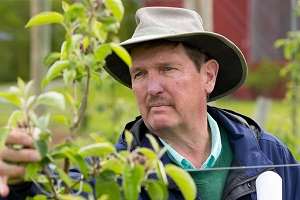
Key to the transformation has been research conducted at Penn State and other universities, and Penn State horticulture professor Rob Crassweller has been at the forefront of the effort to boost apple production for more than 30 years. In his role as a faculty member with Penn State Extension, he has presented those findings to growers.
The college has been conducting research on apple tree rootstock at the Russell E. Larson Agricultural Research Center at Rock Springs since the early 1970s. "We have been cooperatively evaluating rootstock since the mid-70s because rootstock controls tree size, and we must have size control since we don't want trees to be 40 feet tall. We want them to be no more than 14 feet high--so we can pick all of the fruit from the ground."
Crassweller's research has helped growers keep up with changing demands in the apple market because it is not easy for them to change the varieties they produce. It takes time to develop new orchards. "Usually, an apple orchard will be there for 20 to 25 years, so growers are reluctant to change varieties, but because of the new training systems we have developed, growers are able to plant apple trees one year and actually get some fruit off them the next, and certainly in the third year they will have a good crop. These advances allow growers to be more nimble in the marketplace," he said.
One of the biggest challenges apple growers face is producing fruit that is not marred by apple scab, a disease that disfigures and distorts fruit, making it unsuitable for sale. Researchers for years have been attempting to develop varieties that are resistant to apple scab. Crassweller's orchard at Rock Springs has the largest collection of scab-resistant apple varieties in the eastern United States, except for the USDA Plant Repository in Geneva, New York, with about 50 different trees producing scab-resistant apples at Rock Springs among the 140 trees in his research orchard.
The work done by Crassweller is especially important to Pennsylvania because the state is ranked the fourth highest apple-producing state. "My paycheck is blue and white and the taxpayers of the state pay my salary, so I always try to help Pennsylvania growers first," he said. "But in the larger scheme of things, the industry in our region really stretches from Pennsylvania south into western Maryland, West Virginia, and northern Virginia. So, all of our findings are relevant to growing apples in a four-state region."
Source: psu.edu