By Jenna Falor and Madelyn Celovsky
When planting fall cover crops, often fall weather and harvest progress can interfere with the best laid plans for timely cover crop seeding. This leaves many producers asking, how late is too late to see a benefit?
The answer is not as simple as a date on a calendar but rather determined by soil temperature and soil moisture.
Soil moisture and good seed-to-soil contact are crucial for late fall cover crop establishment. Germination is delayed when planting seed into dry soil, especially if broadcasting. If soil is dry and rain is not in the forecast, consider drilling the cover crop. Winter grains do not need a strong stand in the fall to survive and resume growth in the spring. As long as the seeds have absorbed enough moisture to germinate and establish belowground growth before winter, they can continue developing in the spring.
While warmer soil temperatures may optimize germination, some cover crops can germinate at lower soil temperatures, which is what we will be focusing on for the November planted cover crops. In an average year, soil across Michigan’s Lower Peninsula remains above 40 degrees Fahrenheit until late November with southern counties remaining above 40 F until mid-December (Figure 1, Midwest Regional Climate Center).
According to MSU Enivoweather, as of Nov. 2, 2026, the entire state is still above the minimum soil temperature for germination of these winter cereals, though much of the Upper Peninsula and Upper Northern Michigan are getting closer to those minimums.
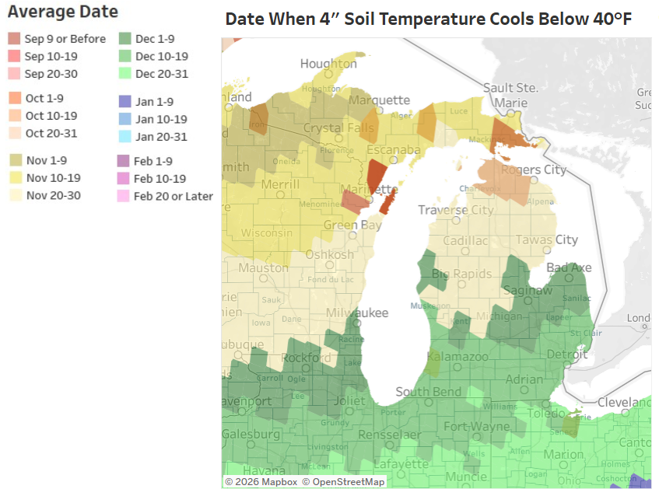
Source : msu.edu