The extreme winter weather that hit the southern Plains States in mid-February may have reduced bull fertility in herd sires – potentially bad news for the economic well-being of cow-calf operations.
Cattle breeders should have a veterinarian check their bulls for frostbite to the animal’s scrotum and testicles as soon as possible so that arrangements can be made to protect the herd’s reproductive efficiency, said Dr. Rosslyn Biggs, Oklahoma State University Extension veterinarian and director of continuing education for the College of Veterinary Medicine.
“Cow-calf operators have too much invested in terms of time, resources, management and money to risk open cows and replacement heifers,” she said. “If bulls must be replaced, the sooner that is known the better, so producers can acquire the best possible sires to meet their herd objectives.”
OSU’s College of Veterinary Medicine recently received a report from a veterinarian in western Oklahoma who conducted breeding soundness examinations on a large group of bulls. More than 40% were deemed unsatisfactory because of cold-weather-related injury.
Frostbite to the scrotum is usually apparent a few days after freezing in the form of inflammation and swelling. Heat generated from the inflammation directly affects sperm that are maturing and stored in the epididymis, which surrounds the testicle at the lower end of the scrotum. A scab may be present, but its absence does not necessarily indicate damages were dodged, Biggs said.
Frostbite can cause temporary or permanent sterility. Producers should work with veterinarians to determine the best course of action to avoid unnecessarily culling a functional herd sire.
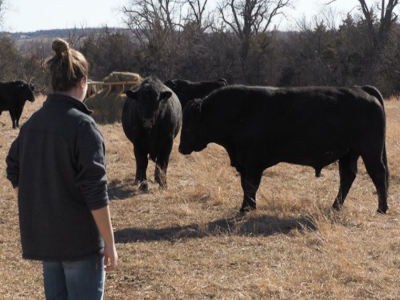
Evaluating bulls after a hard freeze is important for the herd’s productivity. Frostbite to the testicles can hurt a bull’s fertility.
OSU Extension recommendations are to have a breeding soundness examination performed on sires 30 to 60 days before the start of the breeding season regardless of recent weather conditions. Still, it’s best to be extra cautious this year, said Dana Bay, Ellis County Extension Office agricultural educator.
“An examination typically includes a physical evaluation of the feet, legs, eyes, teeth, flesh cover, scrotal size and shape, as well as the entire reproductive tract – including the testicles and epididymis – and a microscopic semen evaluation recording the amount of sperm produced and the percentage of sperm that can swim forward and potentially fertilize the cow or replacement heifer,” she said.
Producers should continue to observe the bull’s body condition, which can be affected by factors including: length of breeding season, grazing and supplemental feed conditions, the number of cows and heifers the bull is expected to service, and travel distance during the season. Ideally, bulls should have enough fat cover at the start of breeding so that their ribs appear smooth across their sides.
“We recommend cattle breeders also get their veterinarians’ input about the need to test a bull for the reproductive disease trichomoniasis,” Bay said. “It’s best not to automatically assume a bull will perform as expected. Treat the producer-veterinarian relationship as a partnership in risk management.”
Research by Albert Barth and Cheryl Waldner first published in 2002 provides additional details about frostbite damages.
Fact sheets detailing research-based information about cattle herd health and reproduction management are available online and through OSU Extension county offices. A video segment detailing OSU Division of Agricultural Sciences and Natural Resources insights about the importance of breeding soundness examinations for bulls is available online as part of the agricultural television show SUNUP.
Oklahoma typically is the nation’s fourth- or fifth-leading producer of cattle and calves annually, according to U.S. Department of Agriculture data.
Source : okstate.edu