Farms.com Home   News

Dry Conditions Brought Warmest Ever High Temperatures to Much of the Region

By Pam Knox

Because of the dry conditions across a lot of the Southeast in September, many stations in the region reported their highest ever average maximum temperature for the month, according to maps from the Southeast Regional Climate Center’s Perspectives tool (https://sercc.com/perspectives). Minimum temperatures were also ranked in the top five at many places but almost none were the warmest min temperatures, so the average temperatures in most cases did not set new records for the month. Precipitation values at many stations were also ranked in the top five driest in many places, but because there can be multiple zeros for completely dry months, it is a little harder to assess what that ranking actually means, other than that it was exceedingly dry. You can use the link above to try it out for your own area or get statistics on a particular station.
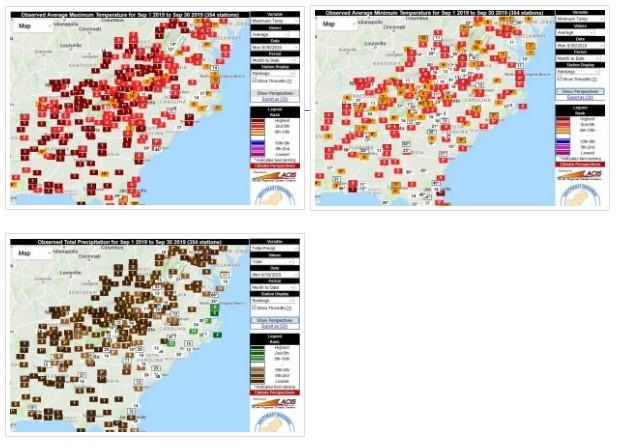
Dry Conditions Brought Warmest Ever High Temperatures to Much of the Region

Source : uga.edu

Trending Video

New research chair appointed to accelerate crop variety development

Video: New research chair appointed to accelerate crop variety development

Funded by Sask Wheat, the Wheat Pre-Breeding Chair position was established to enhance cereal research breeding and training activities in the USask Crop Development Centre (CDC) by accelerating variety development through applied genomics and pre-breeding strategies.

“As the research chair, Dr. Valentyna Klymiuk will design and deploy leading-edge strategies and technologies to assess genetic diversity for delivery into new crop varieties that will benefit Saskatchewan producers and the agricultural industry,” said Dr. Angela Bedard-Haughn (PhD), dean of the College of Agriculture and Bioresources at USask. “We are grateful to Sask Wheat for investing in USask research as we work to develop the innovative products that strengthen global food security.”

With a primary focus on wheat, Klymiuk’s research will connect discovery research, gene bank exploration, genomics, and breeding to translate gene discovery into improved varieties for Saskatchewan’s growing conditions.