By Krishna Ramanujan
When humans first domesticated maize some 9,000 years ago, those early breeding efforts led to an increase in harmful mutations to the crop’s genome compared to its wild relatives, which more recent modern breeding has helped to correct.
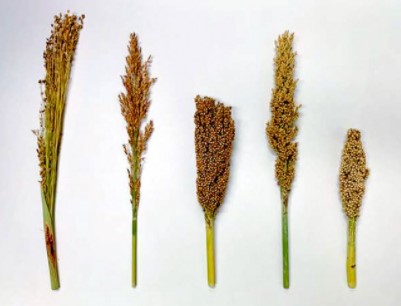
The image shows variation in seed head architecture of the different sorghum races, including (from left to right) bicolor, guinea, caudatum, kafir and durra.
A new comparative study investigates whether the same patterns found in maize occurred in sorghum, a gluten-free grain grown for both livestock and human consumption. The researchers were surprised to find the opposite is true: Harmful mutations in sorghum landraces (early domesticated crops) actually decreased compared to their wild relatives.
The study, “Comparative Evolutionary Genetics of Deleterious Load in Sorghum and Maize,” published Jan. 15 in Nature Plants. The senior author is Michael Gore, Ph.D. ’09, Liberty Hyde Bailey professor and professor of molecular breeding and genetics in the Plant Breeding and Genetics Section in the School of Integrative Plant Science (SIPS) in the College of Agriculture and Life Sciences (CALS).
The research may inform future breeding efforts in both sorghum and maize.
“We assumed that maize and sorghum would have complementary patterns of deleterious mutations, because all the work that has been done in crops up to this point has shown an increase in deleterious burden in domesticates compared to wild relatives from which crops originate,” Gore said. “But sorghum does not follow this pattern and it’s very surprising.”
These “deleterious mutations,” which potentially have a negative effect on the fitness of an organism, result from random genetic errors that occur every generation, and from ancient mutations that may be linked to beneficial genetic variants selected during crop domestication and improvement.
In the study, the researchers ran population genetics simulations to help explain why sorghum failed to follow the same pattern found in maize.
One major difference between maize and sorghum is that maize (wild and domesticated) is an “outcrosser,” meaning its female flowers (ear shoots) are predominantly pollinated by other maize plants; domesticated sorghum is a “selfer,” meaning the flowers of its panicles (heads) are mostly fertilized by each plant’s own pollen.
It turns out that sorghum’s wild relatives have more open seed heads that facilitate outcrossing. But in the process of sorghum domestication, the panicles that hold these clusters of flowers became more compact, which increased “selfing” rates.
“We posit that the alteration of panicle morphology impacted deleterious mutation patterns in sorghum,” Gore said. “The resultant increase in selfing likely contributed to the purging of deleterious mutations after domestication.”
By understanding the historical patterns of harmful mutations, breeders may use that knowledge to better purge deleterious mutations from sorghum crops. “What we’re learning in sorghum could also be applied to maize and vice versa,” Gore said.
Roberto Lozano, a postdoctoral researcher in Gore’s lab, is the paper’s first author. Co-authors include Ed Buckler, a research geneticist at the U.S. Department of Agriculture-Agricultural Research Service and adjunct professor of plant breeding and genetics with Cornell’s Institute of Biotechnology, whose prior research has identified patterns of harmful mutations related to maize domestication and breeding; and Jeffrey Ross-Ibarra, professor of evolution and ecology at University of California–Davis.
The study was funded by the U.S. Department of Energy.
Source : cornell.edu