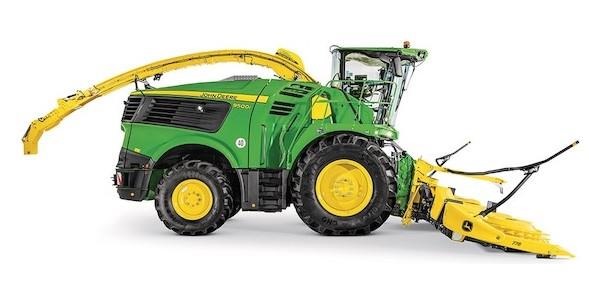
John Deere rolled out the 9000 Series Self-Propelled Forage Harvesters (SPFH) about three years ago. Now, the company is looking to expand upon this series in order to cater to operators who want more assistance harvesting high-quality forage. For model year 2022, Deere will be adding the 9500 model to its lineup of self-propelled forage harvesters. In addition, the 9500 and 9600 models will have an 18.0L John Deere 18X engine for more power.
“Customers want rugged, high-capacity forage harvesters that provide constant maximum throughput with fewer blockages and downtime for service and maintenance, along with the ability to monitor, adjust and document processing of the forage for optimal feed value,” said Chase Milem, John Deere marketing manager for forage harvesters. “From top to bottom, 9000 Series Self-Propelled Forage Harvesters deliver on those needs with comfort and performance.”
With new features, the 9000 Series Self-Propelled Forage Harvesters will help producers improve crop flow and ultimately boost efficiency.
What is a Self-Propelled Forage Harvester?
A self-propelled forage harvester is typically used to make food for livestock. Forage that is created with these machines can deliver a better feed value, which puts the animals in a better position to produce. John Deere’s self-propelled forage harvesters make serviceability a breeze while improving crop flow.
John Deere 9000 Series SPFH Updates
Numerous updates have been made to the 9000 Series Self-Propelled Forage Harvesters. The new 9500 specifically has a rated power of 690 horsepower, as well as a HarvestMotion™ Plus rating of 755 horsepower, which is generated by its inline six-cylinder 18.0L John Deere 18X engine.
Introducing the New John Deere 9500 Combine
The model year 2022 9500 was also designed with improving crop flow in mind. Operators now have more visibility and control during the unloading process. With HarvestMotion Plus, engine speed, crop flow, and power are all synchronized to maintain consistent crop throughput at low RPMs. There is also less fuel consumption, and no diesel exhaust fluid required.
Enjoy Maximum Power with the John Deere 18X Engine
The 18.0L John Deere 18X engine provides unmatched performance. It is a diesel engine, meaning operators don’t have to concern themselves with diesel exhaust fluid. This engine also meets Final Tier 4/Stage V emission regulations, giving operators peace of mind. HarvestMotion Plus allows it to achieve unique power and torque rise in the 700- to 800-PS power class for the utmost efficiency. It also has a long engine oil service interval, peaking at 750 hours, meaning less downtime for operators.
Click here to see more...