By Josh Maples
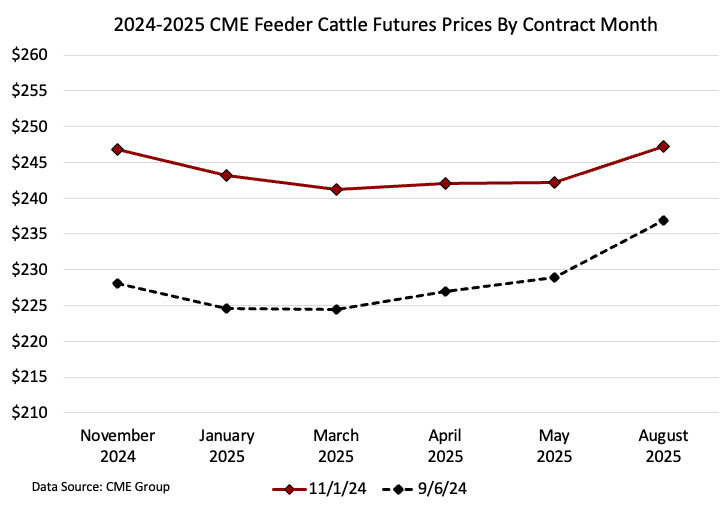
Feeder cattle futures prices rallied in September and October to offset much of the decline that occurred in August. The January 2025 contract dropped roughly $25 per CWT from mid-July to mid-August. Since early September, the price of the January 2025 feeder cattle contract has risen approximately $15 per CWT. Prices for other contracts have followed similar patterns as shown in the chart above. Points on the solid maroon line are the end of day prices from last Friday. Points on the dotted black line are end of day prices on September 6th. We are not back at the high levels seen earlier in the year, but markets have rebounded significantly. Feeder cattle futures contracts are traded on the CME Group exchange.
I want to use this article to talk about seasonality and futures markets. We’ve previously discussed in this newsletter the impact of seasonal patterns on cattle markets. Auction prices are usually lowest in the fall months for 500-pound calves in the southeast when producers are selling the bulk of spring-born calves. Auction prices for 750-pound feeder cattle are typically lowest in the spring months when those calves are yearlings. Futures prices reflect expectations of seasonal patterns too, but there are a few steps to thinking through the impact.
First, it is important to remember that feeder cattle futures prices represent the market’s expectation of what the CME Feeder Cattle Index will be at the end of the contract month. The index is calculated from auction prices for 700-899 pound steers collected by USDA-AMS for a 12-state region in the middle of the U.S. (there are no states east of the Mississippi river included in the index). It is a 7-day rolling weighted average, so the index value for today is really a weighted average of the auction prices over the past week.
How does seasonality fit into this? If prices are typically expected to be lower during certain months (i.e. seasonality), then the futures contract prices for those months will likely be lower because traders are “baking-in” the seasonality expectations. The chart above is a good example. Since these prices reflect 700-899 pound feeder steers, the market (futures traders) is expecting auction prices (the CME index) to be lower during the spring months before rising seasonally as summer approaches.
The chart above does not imply that overall cattle market expectations should be lower prices in 2025. This chart shows market expectations for 700-899 pound feeder steers in a 12 state region at six different contact end dates. If a hypothetical futures market existed for 500 pound calves (it doesn’t), it would show the highest prices near the March contract since that is when prices for that weight class are usually highest.
This exercise illustrates the importance of understanding how the value of your cattle correlates to futures market prices for risk management or for forecasting prices. Your cattle may not be 800-pound steers sold in that 12-state region. But if you know your cattle are usually $10 above or $10 below the futures market at sales time, then then you can still use the futures market’s expectations to forecast the expected value of your cattle and to participate in price risk management tools.
Source : osu.edu