By Lauren Finnegan
Retired U.S. Army Major Joseph Labarbera’s focus has always been clear – service to country. After 22 years of military service, Joseph purchased a 30-acre farm in Stillwater, New Jersey, to raise Dexter cattle and St. Croix sheep. He has since worked with USDA to incorporate conservation practices and grow his operation. If you’re a military veteran interested in agriculture, USDA offers resources to support you and your working land.
A Future in Farming
While deployed to Iraq in 2004, Joseph’s platoon met with a local sheikh. The soldiers were astounded to see date and palm trees surrounding lush farmland in an area that was otherwise dry desert. After the meeting, the sheikh unrolled a scroll with a fig vine containing hundreds of leaves. Written on each leaf was the name of one of the sheikh’s ancestors who had worked the land before him.
“At that moment I thought, no one living in a city or a suburb could ever have this,” Joseph said. “But when you have a farm and you have your own system, you’re the master of your own land, you’re the master of your own life. And when I saw that, I said, ‘This is for me.’”
Sustainability through Silvopasture
After retiring in 2016, Joseph fulfilled his dream by purchasing a 30-acre farm. He immediately began working with USDA’s Natural Resources Conservation Service through the Environmental Quality Incentives Program. NRCS provides financial assistance and one-on-one technical support to address natural resource concerns and strengthen agricultural operations across the nation.
Joseph leveraged EQIP to develop a forest stewardship plan and implement livestock-related conservation practices. He has now installed a new fence, livestock pipeline, and watering facility. He also practices prescribed grazing and silvopasture, an agroforestry practice that combines tree management and grazing animals on the same land to maximize profitability.
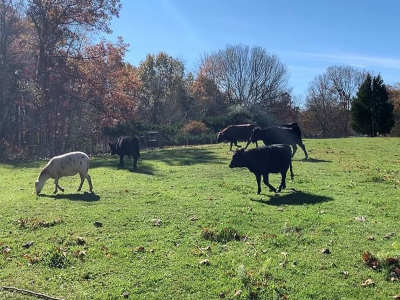
Joseph worked with NRCS to develop a conservation plan for livestock and crop tree production.
“With limited pasture for his livestock, Joseph was interested in using part of the forestland as silvopasture,” said NRCS Soil Conservationist Xanvith “Bea” Sabouathone. “He is one of the first farmers to adopt the practice in the state.”
Bea worked with Joseph to introduce the right mixture of grasses and legumes to balance the forages in his pastures for grazing, all while managing crop trees. Through prescribed grazing, livestock waste is evenly distributed with nutrients cycling back into the soil. As crop trees are harvested, a new generation will be planted to take their place.
USDA Supports Our Veterans
Are you a military veteran interested in farming? USDA offers resources to help you:
- Fund Your Operation: USDA’s Farm Service Agency offers a variety of funding opportunities to help agricultural producers finance their businesses. Certain funds are targeted for veterans and beginning farmers and ranchers.
- Conserve Natural Resources: USDA’s Natural Resources Conservation Service offers conservation programs and expert one-on-one technical assistance to strengthen agricultural operations now and into the future. Veterans may be eligible for a cost share of up to 90 percent and advance payments of up to 50 percent to cover certain conservation practices.
- Manage Risks: USDA is here to help you prepare for and recover from the unexpected. Veterans who are beginning farmers may be eligible for reduced premiums, application fee waivers, increased insurance coverage, and other incentives for multiple USDA programs that support risk management.
Source : farmers.gov