Many fruit growers across the state are incorporating sustainable practices, and many of these practices can be implemented by beginning farmers to show their customers they are being good stewards of the environment.
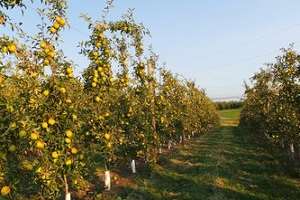
Restaurants have started promoting their use of sustainably grown farm products, and consumers are becoming increasingly concerned about how their food is produced. Generally speaking, sustainably produced fruit is grown in an economical manner with an emphasis on preserving the orchard ecosystem, protecting the natural habitat and wildlife surrounding the orchard, and ensuring the welfare of humans that work and live around the orchard. There are also independent third party certifiers that growers can work with to have their sustainable practices verified.
To preserve your orchard ecosystem and reduce your farm’s reliance on chemical pest control, consider utilizing integrated pest management (IPM) practices. Growers can use many cultural, genetic, biological, and physical practices to reduce pest damage on their fruit. To practice integrated pest management, you will need to closely scout your trees and monitor local weather conditions to know which pests are present in your orchard throughout the growing season. This will allow you to know when pests are present, in what quantity they are present, and whether or not they are likely to cause fruit damage.
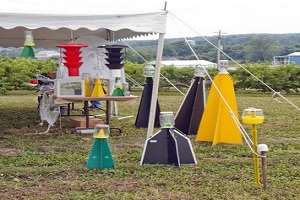
With knowledge of the pest population, you can then choose management practices to reduce pest damage to your crop. One example is mating disruption of internal feeders. To control internal feeders like codling moth and Oriental fruit moth, growers can hang scented lures containing the sex pheromone of the female moth throughout the orchard. The scent of female moths covers the orchard, making it difficult for the males to locate females. This prevents the moths from mating, greatly reducing the number of females laying eggs into the fruit. More information on insect pest management can be found at the Tree Fruit Insects, Mites, and Beneficials page of the Penn State Extension Tree Fruit Production website.
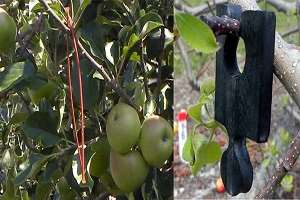
Another IPM strategy is planting disease resistant fruit cultivars. Apple scab is a serious concern for fruit growers in Pennsylvania, but many cultivars have been specifically bred to be resistant to this disease. These varieties are often resistant to other diseases as well, and have performed very well in taste tests with consumers. The scab resistant cultivars CrimsonCrisp and GoldRush will be planted in the spring of 2017 in Penn State’s ‘Models for the Future’ Orchard Bio-renovations project, which consists of four apple demonstration plots located across the state.
In addition to reducing pesticide use, you can grow your fruit more sustainably by making more efficient use of nutrient and water inputs. Conduct regular soil and leaf nutrient analyses to determine how much fertilizer you need to supply. This reduces the risk of over-applying nutrients that may otherwise run off into local waterways. Nutrient runoff can be further reduced by creating buffer strips around waterways surrounding your orchard property. To reduce water use, monitor the weather to determine when to irrigate your trees. Many orchard plantings now utilize drip irrigation lines. This system delivers water directly to the soil where the trees’ roots are, preventing water loss due to evaporation.
Protecting the natural habitat and wildlife around your orchard is another component of sustainable production.
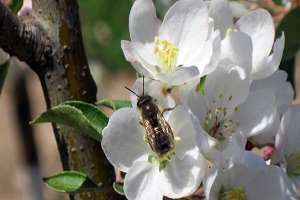
Native bees are highly efficient orchard pollinators, and their populations are vital to the future productivity of our orchards. You can preserve native bees by providing them with food resources, building nesting sites near your orchard, and preventing the over-application of pesticides that are detrimental to bee health. More information on wild orchard pollinators can be found in the publication “Wild pollinators of eastern apple orchards and how to conserve them.”
Another key component of sustainable fruit production includes protecting the welfare of farm employees. Communicate regularly with your employees regarding safety and job satisfaction. Sustainable growers are concerned with the quality of life of their workers and facilitate training of new skills for professional development. Growers also provide important safety training for employees.
A number of marketing/branding programs help producers differentiate their sustainably grown products. These groups develop guidelines for sustainable production and routinely inspect participating growers to ensure their standards are being met. Joining these certifying groups allows for voluntary third-party verification of the orchard’s sustainable practices. This provides a marketing opportunity for the grower, as the grower can prove to their customers they are being good stewards of the environment. In addition to the intangible benefits gained by the surrounding environment, this marketing opportunity creates an economic incentive for following these practices.
Source: psu.edu