By Connie Strunk
Have you been noticing parts of your soybean field turning yellow much earlier than you were expecting? Are some of the plants stunted or showcasing a roller coaster appearance? Soybean cyst nematode (SCN) may be to blame.
SCN (Figure 1) is a silent, yield-robbing pest found attacking the roots of South Dakota soybean plants, oftentimes without showing any above-ground symptoms and resulting in up to a 30% yield loss. SCN has been detected in 34 South Dakota counties (Figure 2).
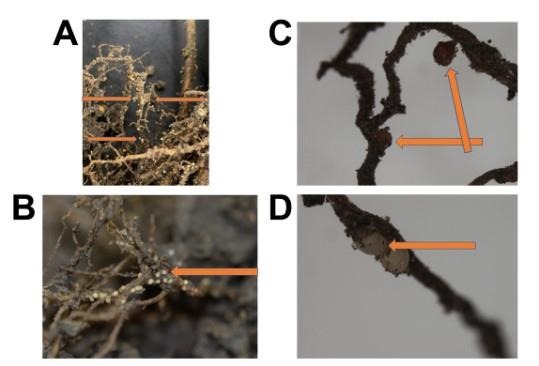
Figure 1. Soybean cyst nematodes on soybean roots. “A” and “B” are examples of SCN seen without a microscope.”C” shows older cysts that will soon detach from the roots and be loose in the soil. “D” is an example of younger cysts that are still attached to the root and have not begun to mature to a darker brown color. Orange arrows indicate individual cysts.
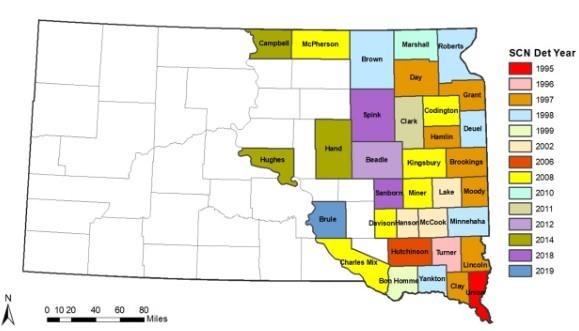
Figure 2. Current South Dakota counties that have been found with the soybean cyst nematode.
SCN Management
SCN management starts with sampling your soil to determine the presence or absence of this nematode. A positive SCN detection requires the adoption of an integrated management approach that includes planting resistant cultivars, crop rotation with non-hosts, and the use of nematicide seed treatments, especially for fields where SCN egg counts are high (>6,000 eggs/100 cc of soil) (Figure 3). A periodic SCN soil test is also needed to monitor the SCN population in the field. An increase in SCN numbers would indicate the methods being used are not working efficiently, and therefore, would call for change in tactics.
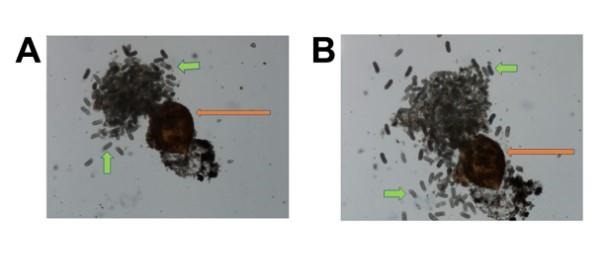
Figure 3. Two views of a single cyst that holds 200 to 300 eggs. “A” demonstrates a mass of eggs coming from the cyst after it was punctured. “B” shows the same cyst with more eggs released. Orange arrows show the cyst, green arrows show single eggs.
SOIL SAMPLING
To take a soil sample for SCN testing, use a soil probe or spade to obtain 15 to 20 soil cores 0 to 6 inches deep, targeting field entrances, low spot areas, consistently low-yielding areas, and along the fence line. Soil underneath soybean rows should be targeted. Bigger fields should be divided into 15-to-20-acre parcels, and each parcel should be sampled alone. Fields which will be planted into soybeans the next growing season should be tested for SCN, so an appropriate SCN-resistant cultivar can be selected.
After you obtain your soil cores from your sampling area, you will want to mix those cores together, as you only need to submit a pint of soil for nematode analysis, being sure to label each sample. Repeat this soil sampling process as many times as necessary to obtain soil samples from targeted areas or from each 15-to-20-acre parcel in the field.
SAMPLE SUBMISSION
SCN testing is free of charge for South Dakota soybean producers, thanks to the South Dakota Soybean Research and Promotion Council. A soil sampling information sheet must accompany the soil samples for SCN analysis.
Source : sdstate.edu