By Zhang Nannan
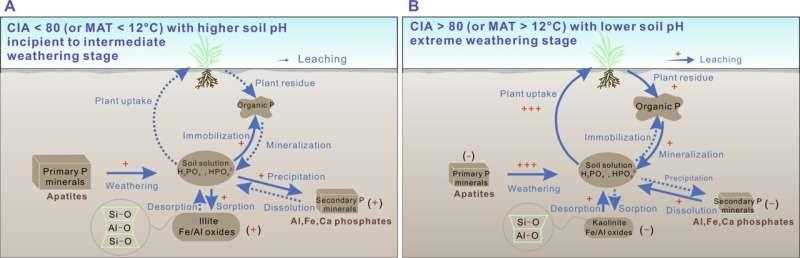
A study published in Science Advances shows that phosphorus (P) release from soils is enhanced at higher mean annual temperatures (MAT). This finding is based on a new compilation of data on global surface soil temperatures and phosphorus content.
Phosphorus released from soils via chemical weathering (referred to as P weathering) plays a critical role in the global cycling of key elements and influences the size of the Earth's biosphere. While it has been theoretically proposed that global climate significantly affects P weathering, direct empirical evidence on a global scale has been lacking until now.
In this study, Profs. Guo Licheng, Zhao Mingyu, Xiong Shangfa, and Yang Shiling from the Institute of Geology and Geophysics of the Chinese Academy of Sciences (CAS), together with their collaborators, compiled a geochemical dataset of global surface soils to investigate the relationship between climate and P weathering.
The dataset shows that temperature is the primary regulator of P mobility. It shows reduced P retention in soils in warmer climates (> 12°C) and with high silicate weathering intensities, characterized by the near-complete leaching of Na+, Ca2+, K+ from fresh regolith.
Further analysis indicates that lower soil pH in high weathering intensity environments promotes the removal of primary apatite and the dissolution of Al, Fe, Ca phosphates. In addition, in such environments, a higher kaolinite/illite ratio results in a decreased P adsorption capacity within clay minerals.
The researchers also calculated the relationship between modern global MAT and P weathering flux based on the observed relationship between MAT and P content, as well as the modern latitudinal distributions of temperature and land area. The model results show a rapid increase in P weathering flux within the global MAT range of 20°C to 23°C.