The unique climate characteristics of the Southern Great Plains allow producers to use wheat as a forage and grain crop (dual-purpose), potentially increasing overall profitability compared to grain-only or forage-only systems. Date of grazing termination is an important factor in determining wheat’s recovery potential and ability to produce grain. First hollow stem (FHS) is the optimal time to remove cattle from wheat pastures to protect grain yield potential.
What is the first hollow stem (FHS) stage of wheat development?
Before the wheat leaf sheaths become erect after spring green-up, the developing growing point, which is below the soil surface, will soon begin to form a tiny head. Although the head is quite small at this point, it has already established some important yield components. At this stage, the maximum potential number of spikelets is determined. Sufficient nitrogen (N) should already be available in the root zone at this growth stage to maximize the potential number of seeds per head.
Once the embryo head has developed, the first internode will begin to elongate, pushing the head up through the leaf sheaths. This first internode will be hollow. This will be visible before you can actually feel the first node (joint, located just above the first internode).
FHS is the point at which a 1.5 cm (about half-inch) length of hollow stem can first be identified below the developing head (Figure 1). This length is roughly equivalent to the diameter of a dime, which makes its identification in the field easier. FHS occurs when the developing head is still below the soil surface. This means that producers have to dig plants out of the ground to measure it.
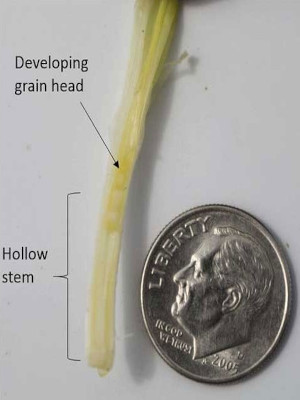
Figure 1. Wheat plant reaching the first hollow stem stage of growth, characterized by approximately 1.5 cm (or roughly the diameter of a dime) of hollow stem underneath the developing grain head.
Assessing for first hollow stem
To look for FHS, start by digging up some plants from fields or areas that have not been grazed, such as field corners or just outside the fence. Date of FHS is variety- and field-specific, so it is important to sample each individual field. Select the largest tillers to examine, and slice the stem open from the crown area up. Look for the developing head, which will be very small. Next, see if you can find any hollow stem between the developing head and the crown area. If there is any separation between the growing point and crown, the hollow stem is elongating. If that separation is 1.5 cm, the wheat plant is at FHS. FHS occurs between a few days to a week or more prior to jointing, depending on temperatures.
Yield losses from grazing past first hollow stem
If the wheat has reached FHS, cattle should be removed to prevent grain yield loss. Yield losses from grazing after FHS can range from 1 to 5% per day, depending on grazing intensity and the weather following cattle removal (Figure 2). If cattle removal is followed by cool, moist weather, yield losses will often average about 1% per day grazed after FHS; if weather is hot, dry, and harsh, yield losses of 5% per day or more can be expected. It is easy for producers to be late by a few days in removing livestock as they wait for obvious nodes and hollow stems to appear, and even the first few days can be significant.
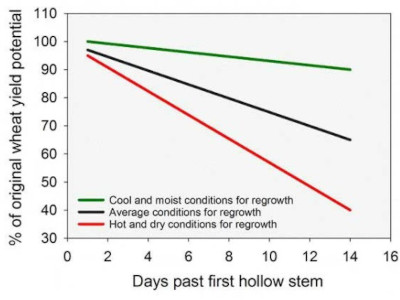
Figure 2. Percent of original wheat yield potential as affected by days of grazing past first hollow stem and weather conditions following grazing termination. Average yield losses by grazing for 14 days past first hollow stem ranged from 10% under favorable conditions to 60% under non-favorable conditions. Research conducted by Oklahoma State University (OSU) and published as K-State publication MF3375 and OSU publication PSS-2178.
Two things can occur when wheat is grazed too long: 1) fewer heads per acre because the primary tiller has been removed, and 2) smaller and lighter heads than expected because leaf area has been removed. As cattle continue grazing, the wheat plant is stressed and begins to lose some of the tillers that would produce grain. A little later, if there are not enough photosynthates, the plant begins aborting the lower spikelets in the head or some of the florets on each head. Finally, if there is not enough photosynthate during grain filling, the seed size will be reduced and if the stress is severe enough, some seed will abort.
Air and soil temperatures during 2021
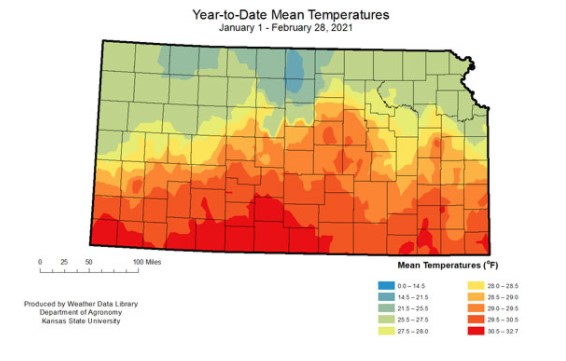
Crop development is mostly a function of available water, nutrients, and temperature. Nutrient availability is field specific and thus we will not discuss it here. Water has been limiting since the fall for the majority of the wheat growing region of the state, which will likely slow down crop development. Likewise, average temperatures across most of Kansas were cooler-than-normal for the period between January 1 and February 28 (Figure 3), which has likely slowed down the progression toward first hollow stem compared to most years. As temperatures increase and wheat begins growing more rapidly in the spring, producers should start thinking about when to pull cattle off pasture to protect grain yields.
Click here to see more...