By Tanner Kelton
The spread of solar-based groundwater pumping for irrigation (SGPI) is reshaping the trade and agricultural policy of arid regions. Promoted as a clean, decentralized alternative to diesel- and grid-powered pumping, solar technology promises to democratize energy access and support rural productivity, a possibility driven by rapidly declining photovoltaic costs. Yet beneath this optimism lies a paradox: by lowering the marginal cost of water, solar irrigation encourages intensified groundwater extraction.
Agriculture remains the dominant livelihood across arid and semi-arid regions like India and Sub-Saharan Africa, but productivity is constrained by erratic rainfall and costly, unreliable diesel and grid power. In Rajasthan, where agriculture contributes nearly 30% of gross value added and two-thirds of cultivated land is rainfed, solar energy is ideally suited to a landscape rich in sunshine but poor in water and infrastructure. Solar irrigation may therefore be framed as a “win-win” for rural poverty reduction, energy access, and the clean energy transition.
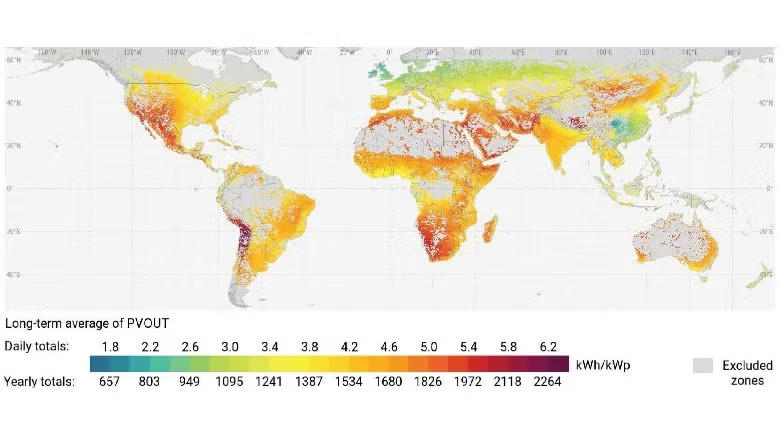
India’s PM-KUSUM program is an example of an SGPI model. Offering capital subsidies covering up to 90% of initial costs, India has helped irrigate more than one million acres by supplying subsidized pumps to 100,000 farmers. By 2026, the government aims to install two million new pumps and convert another 1.5 million existing pumps to solar. A similar expansion is underway in Sub-Saharan Africa. Reduced import taxes and private-sector distribution have created a welcoming policy environment, with the potential for eleven million pumps to be installed. That is enough to meet one-third of unmet irrigation needs for smallholder farmers.
The economic benefits of SGPI are significant. In Rajasthan, farmers who adopted solar pumps were able to increase cropping intensity by 2–10%, simultaneously expanding their cultivation of higher-value, water-intensive crops by 10–116%. This led to significant improvements in both food security and farmers’ profits, particularly for those without grid access. By enabling irrigation throughout the day with zero operational costs, solar pumps effectively decouple water access from rainfall and energy scarcity, allowing farmers to produce more consistently and competitively. At the global level, comparative advantage is shifted as marginal regions are integrated into export markets for water-intensive crops.
Source : upenn.edu